
Explainer: Delhi’s air turns toxic after Diwali almost every year. It is not one cause. Five things pile up at the same time, in the same week. This is what each one does, in plain words.
Updated: 9 November 2026, 10:30 AM IST
Quick Read
- Diwali crackers and Punjab farm fires add a huge burst of smoke in the same week every year.
- Cold winter air puts a lid on the city, and slow winds stop the smoke from blowing away.
- Vehicles, dust and factories keep adding smoke all year — winter just traps it close to the ground.
Start with the number. Delhi’s average AQI was 368 on Monday morning, 9 November, a day after Diwali. Fifteen areas were above 400, in the severe band. A week earlier, on Monday 2 November, the average was 324. The air was already very poor before a single cracker went off. Diwali pushed a bad week over the edge.
1. Firecrackers: the Diwali spike
Crackers are the fastest cause. They burn in a few hours and fill the air with fine dust called PM2.5. That is the dust that harms lungs most, because it is small enough to go deep inside.
On Diwali night, PM2.5 at Akshardham reached 760.99 micrograms per cubic metre at 11 pm, per Delhi Pollution Control Committee data reported by The Hindu. The World Health Organization’s safe limit for a 24-hour period is 15. Anand Vihar recorded 767 at the same hour — about 51 times the limit.
People burst crackers well past the 10 pm deadline set by the Supreme Court. The court’s order allowed only green crackers, and only in two windows: 6–7 am and 8–10 pm, on 7 and 8 November. The full ban is back from 9 November.
Crackers alone do not explain the week. The air was already at 389 on Dhanteras morning, 6 November, before Diwali. So something else was already at work.
2. Farm fires in Punjab: smoke from 300 km away
Every October and November, farmers in Punjab burn paddy stubble to clear fields fast for the next crop. The smoke drifts south-east toward Delhi on the wind.
Punjab recorded 3,144 farm-fire incidents between 15 September and 6 November 2026, per Punjab Pollution Control Board data reported by News18. Tarn Taran topped the list with 611 fires, followed by Ferozepur with 410, Sangrur with 281, Bathinda with 262 and Amritsar with 231. One day alone, Friday 6 November, added 357 fires. Punjab accounted for about half of all farm fires across seven states — 50.5% of 6,226 cases.
How much of Delhi’s smoke is stubble? The Centre told the Supreme Court that stubble burning accounted for about 14% of Delhi’s pollution on Thursday, 5 November. That is a real share, but it is not the whole story. Fines of Rs 54.55 lakh have been imposed in 1,077 cases so far, and 829 red entries have been made in land records. The fires keep coming anyway.
Also read: Delhi AQI 384 on Diwali: 11 areas cross 400
3. Cold air puts a lid on the city
This is the cause most people miss, and it is the one that makes November different from June. In summer, warm air near the ground rises and carries smoke up and away. In winter, the pattern flips. A layer of warm air sits above cold air near the ground. Scientists call it a temperature inversion. Think of it as a lid on a pot.
Under that lid, smoke has nowhere to go. The “mixing height” — how high smoke can rise and spread — shrinks from about a kilometre in summer to a few hundred metres in winter. At night in November and December it can fall below 50 metres, per UrbanEmissions.Info founder Sarath Guttikunda, quoted in The Better India. That is why mornings feel worst: the lid sits lowest after dark, then lifts a little as the sun climbs.
Delhi’s shape makes it worse. The city sits in a bowl between the Himalayas to the north and the Aravalli hills to the south. The mountains block the air from flowing away. The monsoon rains that wash the air clean from July to September are gone by October. Winds slow down. The smoke stays.
4. Vehicles: the everyday base
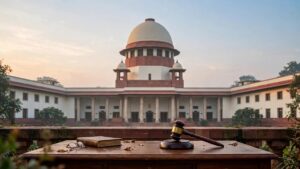
Here is the uncomfortable part. Even with no crackers and no farm fires, Delhi’s air would still be bad. Vehicles run all year, and the Supreme Court said so plainly on 6 November. Hearing a case on Delhi’s air, Chief Justice Surya Kant called vehicular emissions a major contributor and said, “Look at the roads in Delhi and the roads connecting Delhi with the NCR. Take a look at any road and the kind of vehicles moving on it. That is the major problem.”
The court also flagged bumper-to-bumper traffic and asked why the AQI still nears 400 despite years of rules. It will hear the case again on 16 November.
A February 2026 assessment by the Commission for Air Quality Management, based on studies from 2015 to 2025, splits Delhi’s winter PM2.5 like this: secondary particles formed in the air 27%, transport 23%, biomass burning 20%, dust 15%, and industry including power plants 9%. Read that split twice. Vehicles and dust together are more than a third. Farm fires are a fifth. No single cause is the whole answer.
5. Dust, construction and everything else
Road dust, construction dust and open burning add the rest. Delhi builds all year, and dry winter air lifts dust off every road and site. That is why GRAP — the Graded Response Action Plan — stops non-essential construction when the air turns severe. It is also why the plan restricts older cars and puts primary schools on hybrid learning.
Also read: GRAP-3 in Delhi: what changes for you today
What GRAP-3 bans right now
Stage III of GRAP has been in force across Delhi-NCR since Friday, 6 November. In plain words: non-essential construction and demolition work is halted. BS-III petrol cars and BS-IV diesel cars face restrictions on the roads. Primary-school children learn in hybrid mode — part online, part in class. Vehicles from other states that do not meet BS-VI norms cannot enter Delhi, under an annual ban that runs from 1 November to 31 January. Shops, offices, the Metro and buses keep running.
Delhi AQI this week: our own count
| Day | Delhi average AQI | What it means |
|---|---|---|
| Mon 2 Nov | 324 | Very poor |
| Tue 3 Nov | 350 | Very poor |
| Wed 4 Nov | 377 | Very poor |
| Thu 5 Nov | 369 | Very poor |
| Fri 6 Nov (8 am) | 389 | Very poor, 28 stations severe |
| Sat 7 Nov | 369 (daily avg) | Very poor |
| Sun 8 Nov (6 am) | 384 | Very poor, 11 stations severe |
| Mon 9 Nov (7 am) | 368 | Very poor, 15 stations severe |
This table is our own count, put together from CPCB readings in this site’s own posts from 2 to 9 November. Where a reading is a morning snapshot and not a daily average, the time is shown. The pattern is clear: the air climbed all week, from 324 to 389, and Diwali night kept it high. The worst station has stayed above 440 for days. This is a slow build-up, not a one-night spike.
Also read
FAQ
Q: Why is Delhi’s air worst in November?
A: Five things meet in November: Diwali crackers, Punjab farm fires, cold air that traps smoke near the ground, slow winds, and year-round vehicle and dust smoke. Winter also ends the monsoon wash and shrinks the mixing height, so the same smoke makes a worse AQI.
Q: Does stubble burning cause most of Delhi’s pollution?
A: No. The Centre told the Supreme Court stubble was about 14% of Delhi’s pollution on 5 November. A CAQM assessment puts biomass burning at about 20% of winter PM2.5, behind secondary particles (27%) and transport (23%). It is a big share, but not the whole story.
Q: Will GRAP-3 fix Delhi’s air?
A: GRAP-3 slows the damage — it stops construction, restricts older cars and cuts school travel. But the Supreme Court itself asked on 6 November whether old, tried-and-failed steps are all we have. The air will likely stay severe to very poor for days, per the early warning system forecast.
Sources
- Central Pollution Control Board (CPCB) — real-time AQI bulletin, the primary source for the AQI figures
- The Hindu — Supreme Court terms vehicular emissions major contributor to air pollution in Delhi-NCR (6 Nov 2026)
- News18 — Punjab’s stubble burning cases cross 3,000-mark; Tarn Taran among 5 districts under scanner (8 Nov 2026)
- Outlook — Why does Delhi’s air pollution get worse in winter? The science behind the smog (Nov 2026)
- The Better India — Why Delhi’s air can be most polluted before 9 AM and what that means for your morning walk

Sasanka Sekhar Pradhan is the founder of India Presents, an India-focused news site. He covers daily box-office trackers, India news, economy explainers, sports previews and festival guides — in simple English, so readers across India can follow fast-moving stories without jargon. His focus is what a story means for the reader: the number that matters, the source behind it, and what happens next. India Presents publishes daily, with day-trackers updated as new figures come in.

Pingback: Delhi AQI 384 on Diwali: 11 areas cross 400