
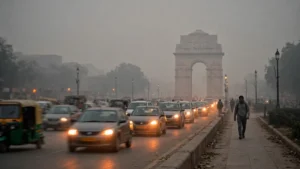
Delhi’s air stayed very poor on Monday morning, a day after Diwali. The city’s average AQI was 368 at 7 am, per the Central Pollution Control Board (CPCB). Fifteen areas had already crossed 400, into the severe band.
Updated: 9 November 2026, 10:30 AM IST
Quick Read
- Delhi’s average AQI was 368 at 7 am on Monday, 9 November — “very poor”, per CPCB data.
- Burari Crossing and Sonia Vihar recorded the worst air at 441 each, and 15 of 59 stations crossed 400 into the severe band.
- PM2.5 hit 760.99 at Akshardham at 11 pm on Diwali night — over 50 times the WHO safe limit — after crackers went on past the 10 pm deadline.
One note on the headline. The “11 areas” is the Diwali-morning count. At 6 am on Sunday, 8 November, 11 stations were above 400. By 7–8 am that day, the count had already risen to 24. On Monday morning it was 15.
The worst areas this morning
Burari Crossing and Sonia Vihar recorded the worst air in the city, at 441 each, per CPCB readings carried by Business Standard. Vivek Vihar stood at 437. Delhi Technological University recorded 434. North Campus of Delhi University and Jahangirpuri recorded 433 each. Rohini was at 430, Bawana at 424, Mundka at 417, Chandni Chowk at 418 and ITO at 406. ITO had already crossed 400 at about 4:20 am.
All 54 stations that reported valid data were above 200. Fifty of them were above 300. The CPCB bands, for reference: 0–50 is good, 51–100 satisfactory, 101–200 moderate, 201–300 poor, 301–400 very poor, 401–500 severe.
Also read: Delhi AQI 384 on Diwali: 11 areas cross 400
50 times the safe limit
The sharpest number of the night is not the AQI. It is PM2.5, the fine dust that harms lungs most. The Hindu reports, from Delhi Pollution Control Committee (DPCC) data, that PM2.5 at Akshardham reached 760.99 micrograms per cubic metre at 11 pm on Sunday. The World Health Organization’s safe limit for a 24-hour period is 15. That makes the Akshardham reading about 50.73 times the limit. Anand Vihar was worse at 767, or about 51.13 times the limit.
Read those numbers with one care: they are hourly peaks at 11 pm, set against a 24-hour safe limit, not a full day’s average. They still show how bad the air got at the peak of the bursting.
Crackers went on past 10 pm
People burst crackers well past the 10 pm deadline set by the Supreme Court. The court’s order of 29 October allowed only green crackers in Delhi-NCR, and only in two windows: 6–7 am and 8–10 pm, on 7 and 8 November. Firecracker activity rose after 5 pm on Sunday and ran through most of the night. The full cracker ban is back from today, 9 November. The Supreme Court hears the Delhi pollution case again on 16 November.
Our own count: Diwali morning vs Monday morning
| When | City average AQI | Stations above 400 | Worst station |
|---|---|---|---|
| Sun 8 Nov, 6 am | 384 | 11 | Jahangirpuri 450 |
| Sun 8 Nov, 7–8 am | 383 | 24 | Jahangirpuri 450 |
| Mon 9 Nov, 7 am | 368 | 15 | Burari Crossing / Sonia Vihar 441 |
This table is our own count, put together from CPCB readings carried by Business Standard, Scroll and The Economic Times. The city average has eased a little, from 384 to 368, but the worst station is still above 440. The daily average for Sunday was 376, against 369 on Saturday. This is not a one-night spike that has cleared. It is a slow build-up, and Diwali night added to it.
Also read: GRAP-3 in Delhi: what changes for you today
GRAP-3 stays on
Stage III of the Graded Response Action Plan (GRAP) is in force across Delhi-NCR. The Commission for Air Quality Management invoked it on Friday, 6 November, two days before Diwali. It halts non-essential construction, restricts BS-III petrol and BS-IV diesel cars, and moves primary schools to hybrid learning. The Air Quality Early Warning System has forecast that the air could slip into the severe category from 9 November and stay there for the next few days.
What to do today
If you must step out, wear a mask — an N95 filters the fine dust far better than a cloth mask. Keep children and older people indoors, and keep medicines close if anyone at home has asthma or a heart problem. Morning and late evening are the worst hours. If your area’s station reads above 400, stay in.
Also read
FAQ
Q: What is Delhi’s AQI today, 9 November 2026?
A: Delhi’s average AQI was 368 at 7 am on Monday, per CPCB data. That is “very poor”. Fifteen stations crossed 400 into the severe band, with Burari Crossing and Sonia Vihar worst at 441.
Q: Why does the headline say 11 areas when 15 are severe today?
A: The 11 is the Diwali-morning count — 11 stations were above 400 at 6 am on Sunday, 8 November. By Monday morning the count had risen to 15.
Q: Is GRAP-3 still in force in Delhi?
A: Yes. Stage III of GRAP has been in force across Delhi-NCR since 6 November. It stops non-essential construction, restricts older BS-III petrol and BS-IV diesel cars, and puts primary schools on hybrid learning.
Sources
- Central Pollution Control Board (CPCB) — real-time AQI bulletin, the primary source for the headline figure
- The Hindu — Air pollution over 50 times WHO limit in parts of Delhi (9 Nov 2026)
- Business Standard — Delhi’s post-Diwali air remains ‘very poor’; 15 locations record severe AQI (9 Nov 2026)
- Scroll — Delhi AQI ‘severe’ in several areas amid Diwali festivities (9 Nov 2026)
- Economic Times — Delhi AQI today: readings turn severe after Diwali bursts (9 Nov 2026)

Sasanka Sekhar Pradhan is the founder of India Presents, an India-focused news site. He covers daily box-office trackers, India news, economy explainers, sports previews and festival guides — in simple English, so readers across India can follow fast-moving stories without jargon. His focus is what a story means for the reader: the number that matters, the source behind it, and what happens next. India Presents publishes daily, with day-trackers updated as new figures come in.


Pingback: Delhi AQI 384 on Diwali: 11 areas cross 400