
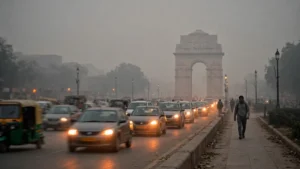
Delhi’s air got a little better on Tuesday morning, but it is still very poor. The bigger story is what happened on Diwali night, when dozens of air monitors stopped sending data just as pollution hit its worst.
Updated: 10 November 2026, 11:00 IST
Quick Read
- Delhi’s AQI was 304 at 8:10 am on Tuesday, 10 November, per CPCB data. That is still “very poor”. Pusa and Chandni Chowk were worst, at 395 each.
- At least 35 of Delhi’s 59 monitoring stations stopped reporting PM2.5 readings on Diwali night. Only 23 of 59 were reporting at 2 am.
- Data released late on Monday shows PM2.5 hit 3,744 at Mundka at 2 am — more than 60 times the national safe limit.
Delhi woke up to slightly cleaner air on Tuesday, 10 November. The average AQI stood at 304 at 8:10 am, according to data from the Central Pollution Control Board (CPCB). That is down from Monday, but it is still in the “very poor” band. The Sameer app, which carries CPCB’s hourly updates, showed 307 at 7:05 am, Scroll reports.
Pusa and Chandni Chowk recorded the city’s highest readings, 395 each. NSUT Jaffarpur followed at 382, and the Commonwealth Sports Complex at 380.
The Diwali-night gap
But the bigger story is the missing numbers from Diwali night. A Times of India investigation, published on 10 November, found that hourly data went missing for at least 35 stations, as per CPCB records. The stations stopped sending readings after PM2.5 levels hit 800 to 1,000 micrograms per cubic metre (µg/m³). PM2.5 is the tiny dust that does the most harm to lungs. The national 24-hour safe limit for it is 60 µg/m³.
At Delhi University’s North Campus, the monitor hit a PM2.5 peak of 999 µg/m³ at 11 pm on Diwali night. Then its real-time data went missing for six hours. CPCB’s website started showing data again only at 5 am on Monday, when PM2.5 had fallen to 723 µg/m³. The pattern was the same across the city. At 10 pm on Diwali night, 57 of 59 stations were reporting. By 2 am, only 23 were. By 1 am, 36 of the 59 stations had no PM2.5 reading in CPCB’s records, the Times of India reports.
A Hindustan Times investigation, published on 10 November and quoted by Outlook India, found the same gap from a different count. It found 43 of the city’s 59 stations had gaps in PM2.5 readings between 10 pm and 6 am.
What the late data showed
The Delhi Pollution Control Committee (DPCC) released the missing hourly readings at about 8 pm on Monday. They were far worse than the official numbers had suggested. Mundka recorded PM2.5 of 3,744 µg/m³ at 2 am on Monday, 9 November. JNU recorded 3,023 µg/m³ at 4 am. NSUT’s West Campus recorded 3,008 µg/m³ at 5 am. Eleven DPCC stations recorded PM2.5 above 2,000 µg/m³, Business Today reports.
Every one of the 125 station-hours missing from CPCB’s records was above 1,000 µg/m³ in the DPCC data. Not one missing hour was below that mark. And no station in CPCB’s own records went above 1,000 all night. The Hindustan Times analysis suggests the ceiling could be linked to the monitoring equipment or to CPCB’s data system.
A government official told the Hindustan Times there were “some technical glitches”, but that all 43 DPCC stations were giving data. The Aam Aadmi Party has alleged the stations were shut down on purpose, The Week reports. That charge has not been proved.
Our own check of the numbers: Mundka’s 3,744 µg/m³ is 62 times the national 24-hour standard of 60. Every missing station-hour was at least 16 times the standard. The Hindustan Times estimated Delhi’s true AQI would have been around 360 if the restored readings had been counted. That estimate does not even cover the missing readings from CPCB- and IITM-run stations, so the real figure could have been higher, Outlook India reports.
Also read: GRAP-3 in Delhi: what changes for you today
Three days of bad air
Here is how the last three days stack up:
| Day | Delhi AQI | What happened |
|---|---|---|
| Sun, 8 Nov (Diwali) | 376 (day average) | Highest Diwali-day AQI since 2021, when it was 382 |
| Mon, 9 Nov | 344 (bulletin to 4 pm); 371 at 10 am | 14 stations severe at 10 am; DTU worst at 439 |
| Tue, 10 Nov | 304 (about 8:10 am) | Still very poor; Pusa and Chandni Chowk worst at 395 |
The Air Quality Early Warning System says the air will stay “very poor” on 10 and 11 November, and the India Meteorological Department has forecast no rain in Delhi until 15 November. Stage III curbs under the Graded Response Action Plan (GRAP) are still in force.
Also read: Why Delhi air turns toxic after Diwali
What this means for you
Today’s 304 is better than Monday. It is not good air. “Very poor” means the air can hurt even healthy people if they stay out long. Children, older people, and anyone with asthma or heart trouble should stay indoors as much as they can. If you must go out, a proper N95 mask helps. A cloth mask does not.
FAQ
What is Delhi’s AQI today, 10 November?
About 304 at 8:10 am, per CPCB data. That is “very poor”. Pusa and Chandni Chowk were the worst, at 395 each.
Why did monitoring stations go blank on Diwali night?
At least 35 of 59 stations stopped reporting PM2.5 after levels hit 800–1,000 µg/m³. A government official blamed technical glitches. The DPCC later released the missing readings, which showed peaks up to 3,744 µg/m³.
How bad was the air really on Diwali night?
Worse than the official numbers showed. The restored data put PM2.5 at 3,744 µg/m³ at Mundka — 62 times the national 24-hour standard of 60. The Hindustan Times estimated the true AQI would have been around 360, and that still leaves out some missing stations.
Also read: Delhi AQI 384 on Diwali: 11 areas cross 400
Sources
- Times of India — Missing readings, conflicting peaks: as pollution peaks in Delhi, 35 stations go blank for hours (10 Nov 2026)
- Scroll — Delhi air quality remains ‘very poor’, nearly ‘severe’ in several areas (10 Nov 2026)
- Outlook India — Delhi smog after Diwali: AQI remains very poor amid severe pollution (10 Nov 2026)
- Business Today — Delhi’s Diwali air hit 3,744 as 125 pollution readings went missing from CPCB records (10 Nov 2026)

Sasanka Sekhar Pradhan is the founder of India Presents, an India-focused news site. He covers daily box-office trackers, India news, economy explainers, sports previews and festival guides — in simple English, so readers across India can follow fast-moving stories without jargon. His focus is what a story means for the reader: the number that matters, the source behind it, and what happens next. India Presents publishes daily, with day-trackers updated as new figures come in.


Pingback: Delhi AQI severe after Diwali: 11 areas over 400