
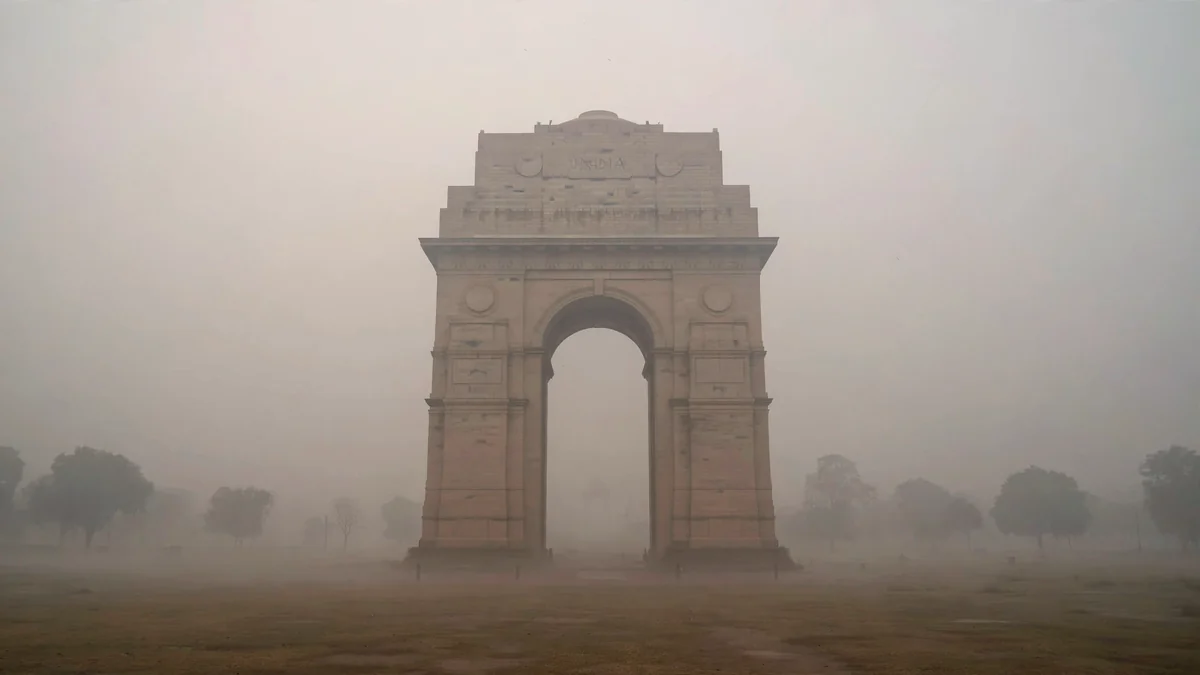
Delhi’s air stayed ‘poor’ on Sunday morning, with the CPCB reading 236 at 7 AM. Fog hung over the city, and live readings later in the morning ran far higher.
Updated: 22 November 2026, 10:05 AM IST
Quick Read
- Delhi’s official AQI was 236 at 7 AM on Sunday, CPCB data shows — still in the ‘poor’ band, but better than Saturday’s 265.
- Chandni Chowk was the worst spot at 304, in the ‘very poor’ band, while a few areas like Mandir Marg stayed just under 200.
- Fog, low wind and a sunny afternoon ahead: the day’s high is 79°F, and GRAP Stages I and II stay in force.
Delhi woke up to fog and dirty air again on Sunday. The city’s official air quality index, or AQI, stood at 236 at 7 AM, according to the Central Pollution Control Board (CPCB). That puts the capital in the ‘poor’ band. It is a small step down from Saturday, when the 4 PM bulletin put the figure at 265. But the air is still far from clean, and the number you see depends a lot on when and how it is measured. Later in the morning, live hourly readings were much worse than the 7 AM figure.
AQI is a single number that sums up how dirty the air is. The CPCB scale runs from 0 to 500. A reading of 0 to 50 is ‘good’, 51 to 100 is ‘satisfactory’, 101 to 200 is ‘moderate’, 201 to 300 is ‘poor’, 301 to 400 is ‘very poor’, and 401 to 500 is ‘severe’. Delhi’s 236 sits in the middle of the ‘poor’ band. That means most people can feel it in their throat and eyes, and people with asthma or heart trouble should take care.
What the morning reading says
The 7 AM figure of 236 comes from the CPCB’s network of monitoring stations across the city. News agency ANI reported the number on Sunday morning, and IANS carried the same figure. The city had registered 265 in the CPCB’s 4 PM bulletin on Saturday, based on a 24-hour average from 56 of the city’s 59 stations. So the official average fell by 29 points overnight — a real improvement, but a small one.
Also read: Delhi AQI 279: Air Stays Poor as Fog Lingers Today
Not every part of Delhi breathes the same air. Chandni Chowk recorded the worst reading on Sunday morning, at 304, which falls in the ‘very poor’ band. Punjabi Bagh was close behind at 298. Bawana stood at 267, Rohini at 260, Anand Vihar at 251, and Ashok Vihar at 244. The ITO area stood at 292, also ‘poor’ but near the top of the band. A few spots did better. Vasundhara Enclave recorded 198, Mandir Marg 199, Alipur 178, and the Major Dhyan Chand National Stadium 146 — all in the ‘moderate’ band. IGI Airport’s Terminal 3 stood at 200, right on the line between ‘moderate’ and ‘poor’. Traffic, dust from building work, and green cover all change from one area to the next, so people should check the reading near their own home before stepping out.
Saturday had been worse. Delhi’s AQI hit 327 at 8:20 AM on Saturday, in the ‘very poor’ band, according to IANS. Sirifort recorded the highest reading that morning at 368, followed by Chandni Chowk at 366, the Commonwealth Sports Complex at 362, Punjabi Bagh at 360, CRRI Mathura Road at 355, and Pusa at 353. Against that, Sunday morning looks better. But one better morning does not mean the smog season is over.
Why two very different numbers are doing the rounds
Some readers will have seen a far scarier number today. A live tracker, DailyAQI, showed Delhi at 432 — ‘severe’ — around 10 AM on Sunday, with PM2.5 at 329 micrograms per cubic metre. That is not a mistake, and it does not mean the CPCB’s 236 is wrong. The two numbers measure different things.
The CPCB’s 236 is a 24-hour average, taken at 7 AM. It smooths out the ups and downs of a full day and night. The live tracker shows what the air is like right now, hour by hour. In Delhi’s winter, pollution builds up overnight when the air is still and cold, so a live reading at 10 AM can run far above the 24-hour average. The 24-hour graph on DailyAQI showed the city’s AQI moving between 316 and 448 over the past day. Both numbers are true. They just answer different questions: how bad was the air over the last day, and how bad is it this minute?
There is a third number in play too. Weather.com, which uses the US scale, put Delhi’s AQI at 266 on Sunday morning and called it ‘Very Unhealthy’, with PM2.5 as the main pollutant. The US scale and the Indian scale are not the same. A US-scale 266 does not mean the same thing as a CPCB 236, and the two should never be mixed up. For Delhi, the CPCB figure is the official one. The US-scale number is only useful if you know which scale you are looking at.
PM2.5 is the tiny dust that does most of the damage. These are specks so small that 30 of them could sit across the width of a human hair. They get deep into the lungs and into the blood. On Sunday morning, PM2.5 was the main pollutant in Delhi on every scale that reported it. That is the number doctors worry about most, and it is the reason masks and purifiers help: an N95 mask blocks these fine specks, and a purifier pulls them out of indoor air.
Fog, sun, and the day ahead
Fog covered Delhi on Sunday morning. Weather.com recorded fog at 68°F with humidity at 71% around 10 AM, and a west-southwest wind of just 2 mph. A slow wind is bad news for air quality. When the air barely moves, smoke and dust stay where they are instead of blowing away. The calm air also lets fog form, and fog traps pollution close to the ground. That is why Delhi’s worst air often comes on still, foggy mornings.
The afternoon looks better, at least for the sky. The forecast says the fog will lift and the sun will come out, with a high of 79°F. Winds pick up a little through the day, reaching 6 mph from the west-northwest by the afternoon. Sunrise was at 6:49 AM and sunset is at 5:25 PM. A light wind of 6 mph will help a bit, but it is not strong enough to clear the air on its own. Monday looks much the same: sunny, with a high of 79°F and a low of 56°F.
Delhi’s winter smog has the same causes every year: smoke from crop burning in nearby states, dust from building sites and roads, and exhaust from vehicles, all piling into air that barely moves. Add fog, and the mix sits over the city like a lid.
Delhi Chief Minister Rekha Gupta reviewed the city’s pollution-control steps at a high-level meeting on 18 November, held at the Delhi Pollution Control Committee’s command centre. No new step was announced in the reports of that meeting.
What GRAP Stages I and II mean for you
GRAP is short for the Graded Response Action Plan. It is Delhi’s step-by-step plan for dirty air. As the air gets worse, more steps switch on. Stage I covers the basic steps, like dust control at building sites. Stage II adds more curbs. Stage III brings tougher steps, like bans on some kinds of building work and limits on older vehicles. Stage III was lifted on 17 November, after the air improved a little. Stages I and II stay in force.
For most people, the stages matter less than the number itself. When the AQI is ‘poor’, the advice is simple. Children, older people, and anyone with asthma or a heart problem should cut down on time outdoors, and skip the morning walk when the fog is thick. If you must go out, an N95 mask helps. At home, keep windows shut in the early morning and run a purifier if you have one. These are small steps, but they cut how much fine dust you breathe in.
Desk-original added context: Delhi’s last three days
The table below is our own count, put together from this site’s earlier posts and today’s verified figures. It shows how the city’s official AQI has moved over the last three days. All figures are CPCB readings.
| Day | Time | CPCB AQI | Band |
|---|---|---|---|
| Friday, 20 November | Morning | 270 | Poor |
| Saturday, 21 November | 7 AM | 279 | Poor |
| Saturday, 21 November | 8:20 AM | 327 | Very poor |
| Saturday, 21 November | 4 PM bulletin | 265 | Poor |
| Sunday, 22 November | 7 AM | 236 | Poor |
Read the table this way: the air got worse through Saturday morning, then eased by the afternoon and again by Sunday morning. The trend is a small improvement, not a clean-up.
One more thing the table shows: the time of day matters as much as the day. On Saturday, the figure jumped from 279 at 7 AM to 327 by 8:20 AM, then fell back to 265 by the 4 PM bulletin. A single reading, taken once, never tells the full story. Check the number at the hour you plan to go out, not just the morning headline.
Also read: Akvan Weakens to Low: No Damage, Rain Moves Inland
Also read: SC Allows Deepathoon Lamp on Nov 24, One-Time Only
FAQ
What is Delhi’s AQI today?
The CPCB reading was 236 at 7 AM on Sunday, 22 November, which is in the ‘poor’ band. Live hourly readings later in the morning were much higher, with one tracker showing 432, or ‘severe’, around 10 AM. The two numbers use different methods, so they are not the same thing.
Is it safe to go for a morning walk in Delhi today?
It is best to skip it. The air was ‘poor’ at 7 AM and live readings got worse later in the morning. Fog also cuts visibility. If you must go out, wait till the afternoon, when the sun is out and the wind picks up a little, and wear an N95 mask.
What is GRAP, and which stage is on now?
GRAP is Delhi’s step-by-step plan for dirty air. Stages I and II are in force now. Stage III, the tougher set of curbs, was lifted on 17 November. The stages switch on and off as the air gets worse or better.
Tomorrow’s forecast puts Delhi’s AQI near 277, still ‘poor’, with a sunny day and a high of 79°F. The air is a little better than Saturday, but it is nowhere near clean yet.
Sources
- Daily Prabhat (ANI) https://www.dailyprabhat.com/delhis-air-quality-remains-in-poor-category-at-236-despite-marginal-dip-in-aqi/ — CPCB 236 at 7 AM Sunday, 265 in Saturday 4 PM bulletin, station-wise readings
- Freshheadline (IANS) https://freshheadline.com/2026/11/22/delhis-air-quality-remains-poor-city-records-aqi-of-236/ — CPCB 236 poor on Sunday, Saturday 327 at 8:20 AM, station highs
- DailyAQI https://www.dailyaqi.com/air-quality/delhi/ — live hourly reading 432 severe around 10 AM, PM2.5 329 µg/m³, 24-hour range 316–448, forecast 277 for Monday
- Weather.com https://weather.com/in/delhi/city/delhi/today — fog 68°F, humidity 71%, US-scale AQI 266 Very Unhealthy, PM2.5 dominant, sunny afternoon high 79°F, sunrise 6:49 AM, sunset 5:25 PM

Sasanka Sekhar Pradhan is the founder of India Presents, an India-focused news site. He covers daily box-office trackers, India news, economy explainers, sports previews and festival guides — in simple English, so readers across India can follow fast-moving stories without jargon. His focus is what a story means for the reader: the number that matters, the source behind it, and what happens next. India Presents publishes daily, with day-trackers updated as new figures come in.



Pingback: Delhi AQI 279: Air Stays Poor as Fog Lingers Today