
A mathematician working with Claude claims a proof of the Riemann hypothesis, unsolved since 1859. Lean checks say the proof is correct, and experts urge care.
Updated: 22 November 2026, 10:15 IST
Quick Read
- Anthropic mathematician Levent Alpöge said on Friday 20 November that he and Claude have found a proof of the Riemann hypothesis, a maths puzzle from 1859.
- On Saturday 21 November, the Lean Focused Research Organization and the Mathlib Initiative said they have “full confidence” the proof is correct.
- The claim is not peer-reviewed yet, and experts say it may take months or years for mathematicians to fully understand it.
A maths puzzle that has beaten every mathematician for 167 years may finally be solved. And the solver, it seems, is not a person working alone. It is a person working with an AI.
On Friday 20 November, Levent Alpöge, a mathematician at Anthropic, the company behind the AI assistant Claude, posted on his website: “I believe I have, working with Claude, discovered a proof of the Riemann Hypothesis.” He also claimed a proof of a wider version, called the Generalized Riemann Hypothesis, which covers a family of related maths objects known as Dirichlet L-functions.
Then, on Saturday 21 November, came the check that made the world sit up. The Lean Focused Research Organization and the Mathlib Initiative said in a joint statement that they have “full confidence that Alpöge’s proof of the Riemann Hypothesis is correct,” the Wall Street Journal reported. The proof was released as a formal check in Lean, a computer system that tests maths proofs line by line. The archive runs to 14 parts and 17 million lines. MIT’s Andrew Sutherland compiled the proof in Lean on his own and called it a “historic moment,” Scientific American reported.
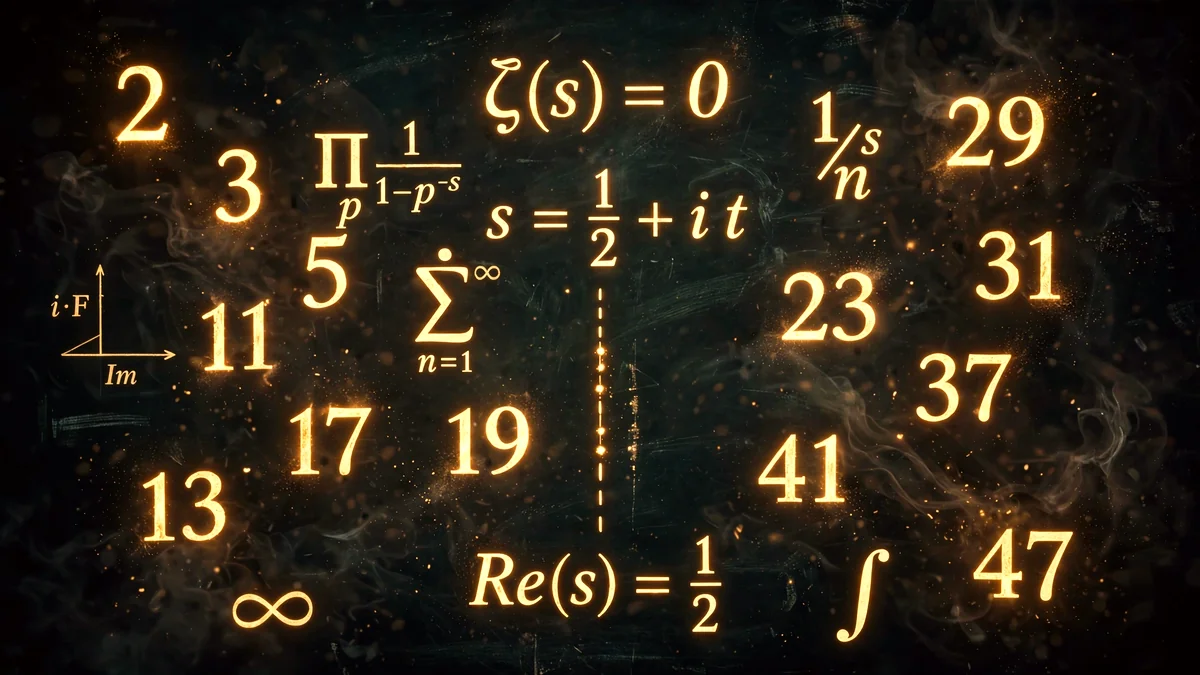
What is the Riemann hypothesis, in plain words
Start with prime numbers. A prime number can only be divided by 1 and by itself. The first few are 2, 3, 5, 7, 11, 13. They go on for ever, but not in a neat pattern. Sometimes two primes sit close together, like 11 and 13. Sometimes there is a long gap with no prime at all. Mathematicians have wanted, for centuries, to know how primes are spread out.
In 1859, a German mathematician named Bernhard Riemann wrote a short paper about this. In it, he made a guess about a maths tool called the zeta function. You do not need to know what that tool is to get the point. The point is this: if Riemann’s guess is true, then primes follow a hidden order. If it is false, that order breaks.
Nobody has proved it either way in 167 years. Computers have tested the guess for trillions of cases, and it has held every time. But testing cases is not a proof. A proof has to show it is true for all cases, for ever.
In 2000, the Clay Mathematics Institute in the US picked seven unsolved maths problems and put a $1 million prize on each one. The Riemann hypothesis is one of the seven. In 26 years, humans working alone solved only one of the seven. The Wall Street Journal reported that an internal OpenAI model solved one more in September 2026.
How the proof was checked
Alpöge did not send a paper to a journal first. He put out the proof as a Lean formalization. Lean is software that checks maths far more strictly than a spell-checker checks spelling. Every step must follow from the step before it, using rules the computer already accepts. If one step is wrong, the computer refuses it. If all 17 million lines pass, the logic holds.
That is why the joint statement matters so much. These are the groups that build and run Lean and its maths library. They checked the work and said they have full confidence it is correct. MIT’s Andrew Sutherland ran the code on his own and got the same result, and Scientific American reported that the proof was “later verified by independent researchers.”
But a computer check is not the same as human understanding. Fields medallist James Maynard, one of the world’s top experts on prime numbers, said: “I suspect that the proof will turn out to be correct.” That is careful praise. He did not say he has read it and agrees with every step. Before this week, the best known result covered 67.25% of the values the hypothesis talks about, per mathematician Youness Lamzouri. The new claim covers all of them.
There is a reason for the care. The proof is huge. Reading 17 million lines of computer-checked maths and turning it back into ideas a person can hold in their head could take months, or years.
Also read: Anthropic IPO: $81 billion, biggest ever
The second claim on the same day
Alpöge was not the only mathematician with news on Friday. On the same day, a second claim about the Generalized Riemann Hypothesis came out from a human working alone. Stanford postdoctoral researcher Alessandro Masullo put out a draft proof, shared by Ravi Vakil, president of the American Mathematical Society, after months of checking by Brian Conrad, another Stanford mathematician, DataCamp reported.
Two claims about the same family of problems, on the same day, is strange. Did both teams find the same idea, or two different ways to the same answer? Nobody can say yet. The two proofs have not been compared in public, and one of them may have a gap the other does not. For now, the Lean check gives Alpöge’s version a head start in trust, because a computer has already tested every step of it.
Alpöge is not new to AI maths headlines. In July 2026, he used Claude and Fable to find a counterexample to the Jacobian conjecture, and a post about it on X was viewed 40 million times. In September, his claimed proof about the Navier-Stokes equations drew sharp pushback. The new claim is far stronger, because it comes with a full computer check. But the September row is a fair reminder: a claim is not a proof until the field accepts it. Anthropic declined to comment on Friday. The company built Claude, but it has not put its own name behind the maths result.
Desk-original added context
The timeline below is compiled by this desk from the sources cited in this article.
| Date | What happened |
|---|---|
| 1859 | Bernhard Riemann publishes his paper and states the hypothesis about prime numbers. |
| 2000 | The Clay Mathematics Institute lists the Riemann hypothesis as one of seven Millennium Prize Problems, with a $1 million prize each. |
| July 2026 | Alpöge uses Claude and Fable to find a counterexample to the Jacobian conjecture. |
| September 2026 | An internal OpenAI model solves one of the seven Millennium problems, per the Wall Street Journal; Alpöge’s Navier-Stokes claim draws pushback. |
| 20 November 2026 | Alpöge posts that he and Claude have found a proof of the Riemann hypothesis and the Generalized Riemann Hypothesis; Masullo’s human-only draft goes public the same day. |
| 21 November 2026 | The Lean Focused Research Organization and the Mathlib Initiative say they have full confidence the proof is correct; MIT’s Andrew Sutherland compiles it on his own. |
What it means for India
For Indian students, this is the most direct maths news in years. The Riemann hypothesis sits in the syllabus of many maths degrees. If the proof holds, textbooks will change: the puzzle teachers called unsolved gets a new chapter, solved in 2026 with the help of an AI.
For Indian researchers, the news cuts two ways. It shows that AI tools like Claude can now do real research maths, not just homework help. A researcher in a small college can now try ideas that used to need a big team. But it also raises a hard question: if a machine can check a proof no human can read in full, who gets the credit, and how does the next generation learn the maths at all?
The $1 million Clay prize goes to a proof that is published and accepted by the maths community, after a waiting period. A website post and a computer check are not enough on their own. Alpöge’s claim still needs a written paper, peer review, and time for other mathematicians to test it.
Also read: Anthropic shares: first day close at $97
What is still not clear
First, there is no journal paper yet. The proof exists as code, not as a paper a mathematician can sit down and read. Until a readable version appears, most mathematicians cannot judge it for themselves. They must trust the computer check. The wider Generalized Riemann Hypothesis claim is also not verified to the same degree: the Lean statement speaks of full confidence in the Riemann Hypothesis itself.
And nothing in daily life changes right away. Some writers have claimed for years that a proof would “upend banking” because primes sit behind encryption. That is wrong. Modern encryption does not depend on the Riemann hypothesis being unsolved. A proof changes maths. It does not change your bank account.
The computer check is a strong signal, Sutherland’s independent compile backs it, and a top expert expects it to hold. But the proof has not yet been read, understood, and accepted by the field. If it survives, it will be one of the biggest maths stories of the century. The next step is the same either way: mathematicians need to read it.
FAQ
What is the Riemann hypothesis in simple words?
It is a guess from 1859 about how prime numbers are spread out. Prime numbers are numbers like 2, 3, 5, 7 and 11 that can only be divided by 1 and themselves. The guess says they follow a hidden pattern, tested for trillions of cases but never proved.
Has the Riemann hypothesis really been proved now?
Not yet, in the full sense. Levent Alpöge says he and Claude found a proof, and the Lean proof-checking system has verified all 17 million lines of it. The Lean groups say they have full confidence it is correct. But no journal paper is out yet, and mathematicians still need to read it before the field accepts it.
Does the proof change banking or internet security?
No. That is a common myth. Modern encryption does not depend on the Riemann hypothesis being unsolved. A proof would change maths and our knowledge of prime numbers, but it would not break bank security.
Also read: Gemini 4 Neon: Google’s launch
Sources
- Wall Street Journal — Anthropic mathematician says Claude has solved the most famous problem in math (PRIMARY for the verification claim: Lean/Mathlib joint statement, OpenAI September solve, $1M prize context): https://www.wsj.com/tech/ai/anthropic-mathematician-says-claude-has-solved-the-most-famous-problem-in-math-9361920b (curl 401, 22 Nov 2026 — paywall; verification claim corroborated by Scientific American and IBM Think below)
- Scientific American — Anthropic mathematician claims to prove Riemann hypothesis (independent verification, Sutherland compile, Maynard quote): https://www.scientificamerican.com/article/anthropic-mathematician-claims-to-prove-riemann-hypothesis-most-famous-problem-in-all-of-math/ (200; fetched 22 Nov 2026)
- IBM Think — Anthropic Claude Riemann hypothesis math proof (background, 17M lines, Lean formalization, no preprint at first): https://www.ibm.com/think/news/anthropic-claude-riemann-hypothesis-math-proof (200; fetched 22 Nov 2026)
- DataCamp — AI solved Riemann hypothesis (Masullo human-only Generalized RH draft, Vakil, Conrad vetting, Alpöge’s July Jacobian counterexample): https://www.datacamp.com/blog/ai-solved-riemann-hypothesis (200; fetched 22 Nov 2026)

Sasanka Sekhar Pradhan is the founder of India Presents, an India-focused news site. He covers daily box-office trackers, India news, economy explainers, sports previews and festival guides — in simple English, so readers across India can follow fast-moving stories without jargon. His focus is what a story means for the reader: the number that matters, the source behind it, and what happens next. India Presents publishes daily, with day-trackers updated as new figures come in.