Astronomers have found a rare triple star system just 28 light-years from Earth, and they say they have no clean explanation for how it got there. Two of its three stars are white dwarfs — the dense, dead remains of stars like our Sun. The team was hunting for planets when it found the system, named Welopōʻai. It is the closest known triple star system with two white dwarfs.
Updated: 24 November 2026, 11:05 IST
Quick Read
- Astronomers found a triple star system just 28 light-years away, named Welopōʻai — the closest known triple system with two white dwarfs.
- The team, led by Étienne Artigau at the Université de Montréal, was hunting for planets with the SPIRou instrument in Hawaii when the star’s motion gave the game away.
- The paper was published in Astronomy & Astrophysics on 19 November 2026. One co-author said: “The system should not exist. We have no clean explanation for how it got here.”
Astronomers hunting for planets have found something stranger instead. Just 28 light-years from Earth sits a triple star system that should not exist — or so its finders say. The system, named Welopōʻai, holds three stars: one living red dwarf and two white dwarfs, the dense dead remains of stars much like our Sun. It is the closest known triple star system with two white dwarfs, and no system like it is known within 100 light-years of Earth. The find was published in the journal Astronomy & Astrophysics on 19 November 2026, in a paper led by Étienne Artigau of the Trottier Institute for Research on Exoplanets (IREx) at the Université de Montréal.
“We were actually looking for planets,” said Artigau, the paper’s lead author. “Instead, we found something much more surprising.” The team had spent years watching a small red dwarf star with a tool built to spot planets. The star moved in a way no planet could explain. What they found in the end was a dead star hiding beside it — and then a third star, already known, circling the pair from far away. The story is a reminder that the sky near Earth still holds surprises, even after centuries of star maps.
The system is now the top search in India on Google Trends, with more than 200 searches today. That is no surprise. A star system that “should not exist”, sitting close enough to be called a neighbour, is the kind of story that travels fast. This post sets out what the team found, why it puzzles them, and what 28 light-years really means.
How a planet hunt found a dead star
The find began with SPIRou, a high-precision tool fixed to the Canada-France-Hawaii Telescope on Maunakea, Hawaii. SPIRou is built to find planets by watching stars wobble. When a planet circles a star, its gravity tugs the star a tiny amount, back and forth. SPIRou measures that wobble in the star’s light. A planet’s tug is small and neat. The tug the team saw on this red dwarf was neither.
The star’s speed swung by nearly 16 kilometres per second — about 57,600 kilometres per hour, or more than 1,000 times the wobble a planet would cause. After almost five years of watching, the team worked out that the unseen companion had a mass greater than half that of our Sun. A planet cannot weigh that much. A normal star that heavy would shine bright. But the companion gave off almost no light. As Charles-Antoine Parent, a masters student at the Université de Montréal and a co-author, put it: “The object’s unusual combination of high mass and dim light left only one plausible explanation: it was the remains of a dead star.”
At first the team could not be sure what kind of dead star it was. A white dwarf was the most likely answer, but a neutron star or even a small black hole could not be ruled out from the wobble alone. To settle it, they turned to the Gemini North telescope, also on Maunakea. Using its ʻAlopeke camera, which takes very sharp images, they saw the faint companion with their own eyes, so to speak. It was a white dwarf, sitting close to the red dwarf. The hidden star had a name at last.
Three stars, one strange family
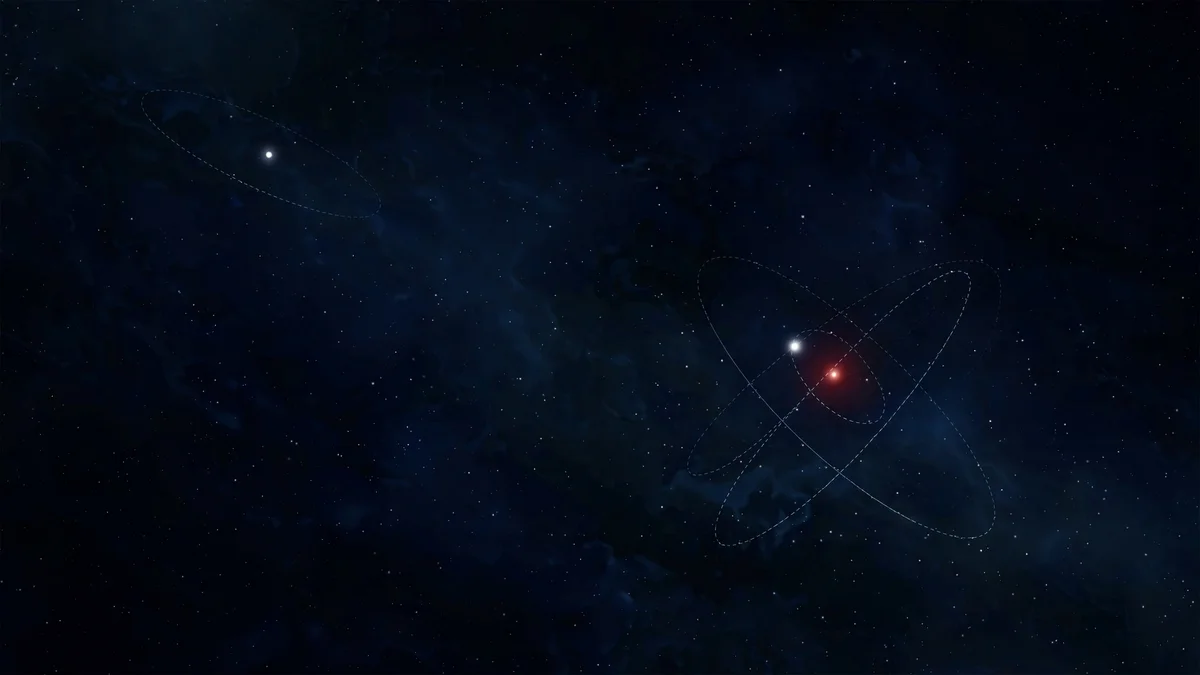
The system has three members, each with its own name. The red dwarf is Welopōʻai Aa. The newly found white dwarf, close beside it, is Welopōʻai Ab. The second white dwarf, already known and circling the pair from much farther away, is Welopōʻai B. The red dwarf is a mid-M dwarf, known in star lists as IRAS 21500+5903. The inner pair — the red dwarf and its white dwarf companion — orbit each other closely. The outer white dwarf circles the pair from a much greater distance.
The name Welopōʻai comes from Hawaii. It was chosen through A Hua He Inoa (“Calling Forth a Name”), a programme of the ʻImiloa Astronomy Center of Hawaii that pairs Hawaiian language experts with astronomers to name new finds. The name joins welo, an inherited or family trait, with pōʻai, an orbit or circling path. Together they mean something like “path of family traits” — a fitting name for three stars bound by one shared past.
The team measured the new white dwarf’s mass with rare care. By joining years of wobble data with the direct images from Gemini, they fixed its mass to better than 1% error. That makes it one of only a few nearby white dwarfs with such an exact mass. That care matters. White dwarfs are the end state of most stars in our galaxy, including our Sun. Exact masses test the models of how stars age, how white dwarfs are built inside, and how matter behaves under crushing density.
Also read: Gemini 4 Neon vs GPT-6.2 Astra: Who Leads?
Why the system should not exist
The puzzle is the system’s past. Before it died, the new white dwarf was a star about 40% more massive than the Sun. As it aged, it swelled into a giant star, growing to hundreds of times its old size. At that stage, the red dwarf would have been orbiting close enough that a violent meeting was almost certain. In most systems like this, the swelling giant swallows its companion, drags the two stars into a far tighter orbit, or even merges with it.
None of that happened here. Against the odds, the red dwarf came through the giant’s death and still sits in a surprisingly wide, steady orbit with its dead companion. “The system should not exist,” said Professor Patrick Dufour, a white dwarf expert at the Université de Montréal and a co-author of the study. “We have no clean explanation for how it got here. That is the question driving our next observations.”
There is one more twist. If the outer white dwarf’s orbit is tilted enough against the inner pair’s orbit, its gravity should slowly stretch and squeeze the inner pair’s path, over and over, in a cycle known as Kozai-Lidov oscillations. Those cycles change the shape of the inner orbit and its tilt in space. The team expects them to happen in Welopōʻai, but they do not yet know the exact three-dimensional shape of the orbits. Until they do, they cannot say how strong the effect is — or whether it helps explain how the system came to look this way. Pinning down those orbits is one of the team’s next jobs.
How far is 28 light-years, in plain words?
A light-year is the distance light travels in one year. Light moves at about 300,000 kilometres per second. In a year, that adds up to about 9.46 trillion kilometres. Multiply by 28, and Welopōʻai sits about 265 trillion kilometres from Earth. That number is too big to picture, so here is a plainer way to think about it. The light leaving Welopōʻai today will reach Earth in 28 years — in 2054. The light we see from it now left the system in 1998, the year Google was founded.
By space standards, 28 light-years is close. Our galaxy, the Milky Way, is about 100,000 light-years across. The nearest star system to us, Alpha Centauri, is 4.37 light-years away. Welopōʻai is about six and a half times farther than that — still a neighbour, in galactic terms. No probe from Earth has ever come close to such a distance. Voyager 1, the farthest human-made object, is less than one light-day from Earth after nearly 50 years of travel.
The table below sets Welopōʻai next to the two nearest triple star systems we know, so the find sits in context.
| System | Distance from Earth | Stars | White dwarfs |
|---|---|---|---|
| Alpha Centauri | 4.37 light-years | 3 — two Sun-like stars plus red dwarf Proxima Centauri | None |
| 40 Eridani | About 16 light-years | 3 — an orange dwarf, a white dwarf and a red dwarf | 1 |
| Welopōʻai | 28 light-years (8.46 parsecs) | 3 — a red dwarf and two white dwarfs | 2 — the most of any nearby triple |
The table shows why astronomers are excited. Alpha Centauri is nearer, but it holds no dead stars. 40 Eridani is nearer too, and it holds one white dwarf. Welopōʻai is farther than both, yet it holds two white dwarfs in one system — and no system like it is known within 100 light-years. It is the closest known triple with two white dwarfs, and the paper says it has no known twin within 30 parsecs, or about 98 light-years.
What the find tells us about our Sun
White dwarfs are not exotic curiosities. They are the fate of most stars, including our Sun. In about five billion years, the Sun will swell into a giant, shed its outer layers, and leave behind a white dwarf about the size of Earth but with about half the Sun’s mass packed inside it. A teaspoon of white dwarf matter would weigh about as much as a small car. Welopōʻai is a live test of that story, with two white dwarfs in one system to study at once.
The find also shows how much of astronomy still runs on luck. The team set out to find planets. They found a dead star instead, because one red dwarf wobbled far too hard for any planet to explain. “Discoveries like this remind us that our own cosmic neighborhood still contains remarkable surprises,” said Artigau. “Even when we’re searching for planets, our Universe often has something completely unexpected waiting for us!” The paper’s authors span ten countries — Canada, Spain, Burkina Faso, France, Switzerland, the United Kingdom, the United States, Chile, China and Portugal — a sign of how much modern astronomy is a team effort across borders.
For readers in India, there is a small local hook. The system is the top trending search in the country today, and its name is easy to say once you hear it: veh-loh-poh-ah-ee. It will not be visible to the naked eye — the red dwarf is far too dim, and the white dwarfs are fainter still. But its story is easy to follow from here, and the next round of watching will be worth waiting for.
Also read: Sarvam 105B India’s New AI Model Goes Big
What we still don’t know
The biggest gap is the system’s past. The team has no clean story for how the red dwarf survived its companion’s death in a wide, steady orbit. More watching may fill that gap, but it may also deepen it. The three-dimensional shape of the orbits is still unknown, so the team cannot yet say how strong the Kozai-Lidov cycles are, or whether they shaped the system. The outer white dwarf’s own past is also less studied than the inner pair’s.
There are also limits to what we know about the stars themselves. The paper gives the inner white dwarf’s mass to better than 1%, but the red dwarf’s exact age and the outer white dwarf’s mass are less pinned down in the reports we read. And no planets have been found in the system. The team was hunting for them, and the wobble that hid the white dwarf would have drowned out the tiny tug of any small planet. That does not mean no planets exist there. It means this search could not have seen them.
The next steps are clear from the paper. The team will keep watching Welopōʻai to fix the orbits in three dimensions, and to test whether the outer star’s pull explains the inner pair’s strange history. The simulation video the institute released, which turns the stars’ motions into sound, gives a taste of the dance they are trying to map. This desk will report back when the follow-up work lands.
Also read: OpenRouter Expels 3 Providers After Prompt Leaks
FAQ
What is Welopōʻai?
Welopōʻai is a triple star system 28 light-years from Earth, found by a team led by Étienne Artigau at the Université de Montréal. It holds a red dwarf and two white dwarfs — the dense, dead remains of stars like our Sun. It is the closest known triple star system with two white dwarfs, and no system like it is known within 100 light-years.
Why do astronomers say it should not exist?
Before it died, the close white dwarf was a star about 40% more massive than the Sun. As it aged it swelled to hundreds of times its old size, which should have swallowed its red dwarf companion or dragged the pair into a far tighter orbit. Instead the red dwarf survived in a wide, steady orbit. As co-author Patrick Dufour put it: “The system should not exist. We have no clean explanation for how it got here.”
How far away is 28 light-years?
A light-year is the distance light travels in one year, about 9.46 trillion kilometres. So 28 light-years is about 265 trillion kilometres. Light leaving Welopōʻai today will reach Earth in 2054, and the light we see now left in 1998. By galaxy standards it is close — our Milky Way is about 100,000 light-years across — but no human probe has ever travelled anything like that far.
Sources
- Université de Montréal / IREx — Astronomers Discover Remarkable Triple-Star System Just 28 Light-Years from Earth (PRIMARY: discovery, team, SPIRou, Gemini North ‘Alopeke, 16 km/s wobble, mass > half the Sun, mass to <1%, 40% more massive progenitor, Dufour quote, Kozai-Lidov, name, paper date 19 Nov 2026): https://exoplanetes.umontreal.ca/en/astronomers-discover-remarkable-triple-star-system-just-28-light-years-from-earth/ (curl returned no response; page read in full via browser fetch, 19 Nov)
- Phys.org — Astronomers discover remarkable triple-star system just 28 light-years from Earth (no comparable system within 100 light-years, DOI 10.1051/0004-6361/202661214): https://phys.org/news/2026-11-astronomers-remarkable-triple-star-years.html (200; 19 Nov)
- Universe Today — A Triple Star System ‘That Shouldn’t Exist,’ Only 28 Light-Years from Earth (paper title, 8.46 pc, no analogue within 30 pc, M4 V dwarf IRAS 21500+5903, 4.8 years of data): https://www.universetoday.com/articles/a-triple-star-system-that-shouldnt-exist-only-28-light-years-from-earth (200; 20 Nov)
- Popular Science — A rare triple-star system near Earth ‘should not exist’ (Dufour quote, velocity swings near 10 miles per second, 20 Nov): https://www.popsci.com/science/rare-triple-star-system-near-earth/ (200; 20 Nov)
- Space.com — The Nearest Stars to Earth (Alpha Centauri 4.37 light-years, triple system, Proxima 4.24 light-years): https://www.space.com/18964-the-nearest-stars-to-earth-infographic.html?platform=hootsuite&s=09 (Jan 2022)
- Little Astronomy — 10 Nearest Stars to Earth (Alpha Centauri 4.37 light-years; 40 Eridani about 16 light-years, triple with a white dwarf — used for the comparison table): https://littleastronomy.com/nearest-stars-to-earth/

Sasanka Sekhar Pradhan is the founder of India Presents, an India-focused news site. He covers daily box-office trackers, India news, economy explainers, sports previews and festival guides — in simple English, so readers across India can follow fast-moving stories without jargon. His focus is what a story means for the reader: the number that matters, the source behind it, and what happens next. India Presents publishes daily, with day-trackers updated as new figures come in.