
Game 3 of the World Chess Championship ended in a draw on Thursday, 26 November, after 60 moves and about five hours of play. The score is now 1.5-1.5. Today, Friday 27 November, is the first rest day. Game 4 is on Saturday, 28 November, at 19:30 IST, and Gukesh plays White.
Updated: 27 November 2026, 10:30 IST
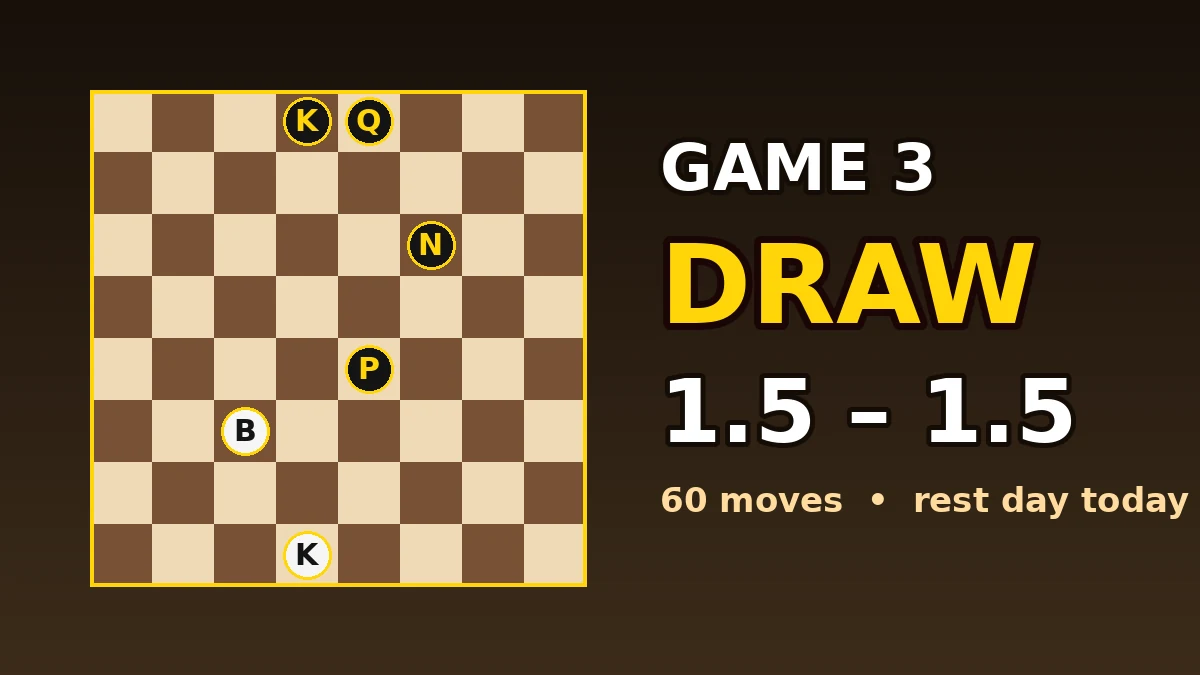
Quick Read
- Game 3 in Geneva ended in a draw after 60 moves and about five hours. It is the third draw in a row, and the score is 1.5-1.5.
- Gukesh surprised Sindarov with a rare opening idea, then found a strong pawn break, but Sindarov held on in a long endgame.
- Today is the first rest day. Game 4 is on Saturday at 19:30 IST, with Gukesh playing White.
The FIDE World Chess Championship 2026 is being played in Geneva, and Game 3 on Thursday ended in a draw after 60 moves, according to Chess.com. FIDE is the world chess body, the group that runs the championship. The match is 14 games long. The first player to reach 7.5 points wins the title. The prize fund is $2.5 million.
Both players are 20 years old. That makes this the youngest title match ever. Sindarov, from Uzbekistan, is rated 2782. Gukesh, from India, is rated 2710. A rating is a number that shows how strong a player is. Higher is stronger. So Sindarov starts as the higher-rated player, but Gukesh is the defending world champion.
The venue is the Fondation Martin Bodmer, in Cologny, Geneva. Three games are done. All three are draws. Neither player has won a game yet. That sounds dull on paper. It was not dull in the room. Game 3 had a fast start, a time scramble, and a missed win that Gukesh himself pointed out after the game.
Also read: Gukesh vs Sindarov Game 3: World Chess Championship
A surprise in the opening
Sindarov had White in Game 3. White moves first, so White usually sets the tone. He opened with 1.e4, the king’s pawn two squares forward. It is the most direct opening in chess. Gukesh answered with the Berlin Defence, a solid reply that top players trust in big matches.
Then came the surprise. On move five, Gukesh played 5…Be7, the Rio de Janeiro Variation. In Game 1, he had played 5…Nd6 in the same spot. A new move in the same opening is a clear message: I have prepared something different. Sindarov had to think from scratch, and his clock paid the price.
The clock told the story of the opening. Gukesh played his first 15 moves in just 2 minutes 12 seconds. Sindarov had spent 58 minutes on the same 15 moves. In plain words, Gukesh knew what he wanted. Sindarov was still working it out. A big time lead like that is a real edge in chess, because the player with less time must rush later.
Also read: New Zealand vs India second Test preview
The middle game: a pawn break, then a scramble
Gukesh’s big idea came on move 33. He played 33…c5!, pushing a pawn to break open the centre. The exclamation mark is the mark chess writers give a strong move. The break gave Black, Gukesh, a passed pawn on d3. A passed pawn is a pawn with no enemy pawn in front of it. It can run to the last rank and turn into a queen. That is why it is so dangerous.
Sindarov was in deep trouble on the clock by then. Before the move-40 time control, he was down to six to eight seconds on some moves. There is no extra time added per move until move 41. So every move before that point had to be played almost at once. One slip, and the game could have ended on time alone. He did not slip.
Sindarov held on. He found the right defence, move after move, and the game went into an endgame. An endgame is the last part of a chess game, when few pieces are left. This one had bishops of opposite colours. That means one player’s bishop moves on light squares and the other’s on dark squares. Such endings are often drawn, because the bishops can never capture each other.
| Game | Result | Score after game |
|---|---|---|
| Game 1 | Draw | 0.5-0.5 |
| Game 2 | Draw | 1.0-1.0 |
| Game 3 | Draw (60 moves) | 1.5-1.5 |
Eleven games are left. Each player needs 6 more points to reach 7.5 and win the match. A win is worth 1 point and a draw is worth half a point. So six wins would do it, but so would a mix of wins and draws. At this pace, with three draws in a row, the first win will change the whole match.
The missed win Gukesh found after the game
The game ended in a draw by repetition. That means the same position came up three times, and either player can claim a draw. It was a fair result on the board. But after the game, Gukesh pointed out something sharp. He said 49…Re3+! would have won for Black. Sindarov, at the board, had thought 49…Re8 was drawn. Gukesh’s remark is his own post-game view, not a fact proven at the board. Still, it shows how close the game came to a win.
That is the kind of detail that makes this match worth following. A draw can hide a win that neither player saw in time. Sindarov survived the clock scramble and the pawn break. Gukesh found the idea only after the game ended. Both men walk away with half a point, but Gukesh walks away with the better story.
One small note on the move count. Chess.com and ChessBase both say the game lasted 60 moves. One wire report says 61 moves. This post uses 60, from the two chess sources, and flags the 61-move version here so readers are not confused if they see it elsewhere.
Also read: New Zealand vs India first Test drawn in Wellington
What comes next
Today is the first rest day of the match. No game is played. Both players get time to rest and prepare. Rest days matter in a long match. Five hours at the board, with the clock pressing, takes a toll. The player who uses the rest day best often starts the next game sharper.
Game 4 is on Saturday, 28 November, at 19:30 IST. That is 15:00 in Geneva. Gukesh plays White. White moves first, and Gukesh will have had a day to prepare a new idea. Sindarov will have had the same day to prepare his answer. After three draws, the pressure to win a game grows with each round.
The match is still wide open. Sindarov is the higher-rated player. Gukesh is the champion. Neither has blinked yet. If Game 4 brings the first win, the score will read 2.5-1.5, and the match will feel very different. Until then, it is level at 1.5-1.5, with 11 games to go.
FAQ
What is the score in the World Chess Championship?
After three games, the score is 1.5-1.5. Games 1, 2 and 3 were all draws. The first player to reach 7.5 points in 14 games wins the title.
When is Game 4?
Game 4 is on Saturday, 28 November, at 19:30 IST (15:00 in Geneva). Gukesh plays White. Today, Friday 27 November, is the first rest day.
Did Gukesh miss a win in Game 3?
Gukesh said after the game that 49…Re3+! would have won for Black. That is his own post-game remark, not something proven at the board. The game ended in a draw by repetition after 60 moves.
Sources
- Chess.com — 2026 FIDE World Chess Championship, Game 3, 26 November 2026 (primary source)
- ChessBase India — World Championship 2026, Game 3 report, 26 November 2026
- ChessBase India — Game 3 ends in a draw after 60 moves, 26 November 2026

Sasanka Sekhar Pradhan is the founder of India Presents, an India-focused news site. He covers daily box-office trackers, India news, economy explainers, sports previews and festival guides — in simple English, so readers across India can follow fast-moving stories without jargon. His focus is what a story means for the reader: the number that matters, the source behind it, and what happens next. India Presents publishes daily, with day-trackers updated as new figures come in.


Pingback: Gukesh 1-1 With Sindarov as Game 3 Begins