This is an explainer. It answers, in plain words, what delimitation is, why it is tied to the women’s quota, and what could change when Parliament meets from 30 November. No prior knowledge is needed.
Updated: 27 November 2026, 10:30 IST
Quick Read
- Delimitation means redrawing Lok Sabha seats after a Census, so each MP stands for roughly the same number of people.
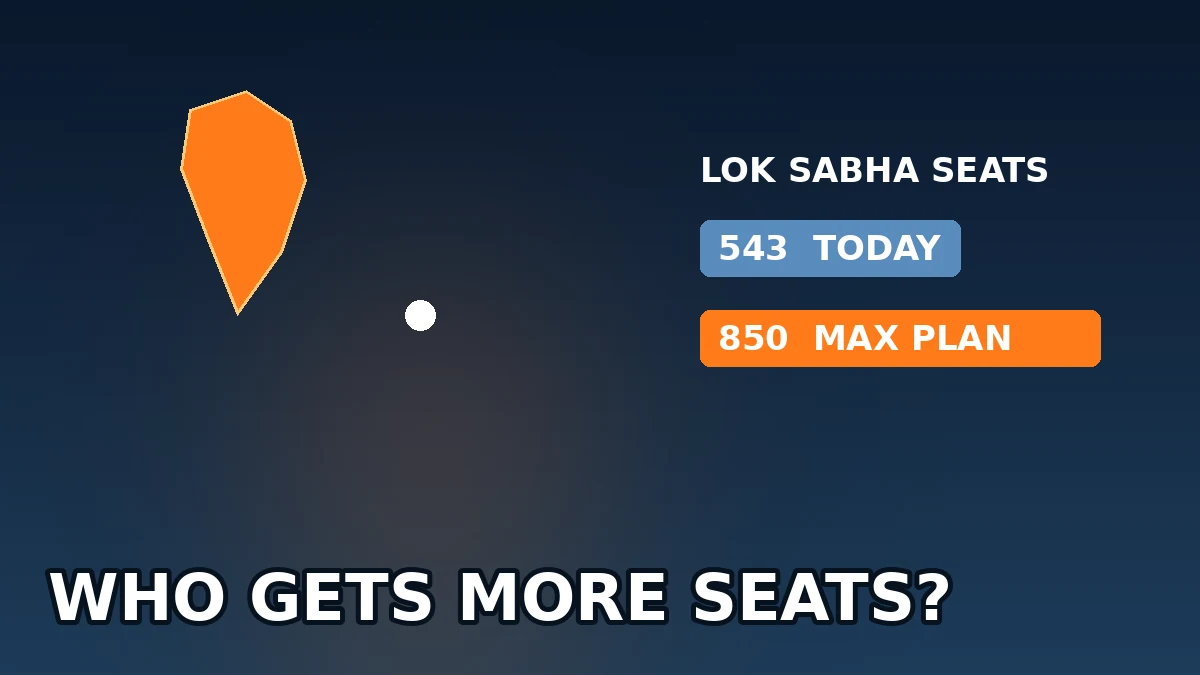
- Seat numbers have been frozen since 1976. The Lok Sabha still has 543 seats, based on the 1971 Census.
- The 33% women’s quota is already law, but it starts only after delimitation. That link is the whole fight.
What is delimitation, in plain words
Delimitation is the redrawing of election seats. After each Census, the country counts its people. Then a body called the Delimitation Commission redraws the map of Lok Sabha seats and state assembly seats, so that each MP stands for roughly the same number of people.
Think of it like school benches. If one class has 80 pupils and another has 40, but both get one teacher, that is not fair. Delimitation fixes that kind of gap. It makes sure a vote in one state counts about as much as a vote in another.
The Constitution says seats must be shared out in proportion to population. A state with more people should have more MPs. A state with fewer people should have fewer. That is the basic rule. But India has not followed it for 50 years. The reason is a freeze.
Why the seats have not changed since 1976
In 1976, the government froze the number of seats each state holds. The freeze came through the 42nd Amendment to the Constitution. Seats were fixed on the basis of the 1971 Census. The idea was simple: states that controlled population growth should not be punished with fewer seats.
At the time, the fear was real. If seats followed population, states that kept families small would lose MPs, while states with fast growth would gain. The freeze was meant to run till the first Census after 2000. Then the 84th Amendment, passed in 2001, pushed it further — till the first Census after 2026.
That date is now here. The next Census has 1 March 2027 as its reference date, according to PRS Legislative Research. So the freeze is set to end, and the question of how to share out seats is back on the table after half a century.
The Lok Sabha has had 543 seats since 1977. The law caps the House at 550 members — 530 from states and 20 from Union Territories. Any rise beyond 550 needs a change to the Constitution itself.
Inside each state, boundaries did change once. The last Delimitation Commission was set up in 2002 and finished its work in 2008. It redrew constituency borders within states, using the 2001 Census. But it could not change how many seats each state gets. That part stayed frozen.
One number shows how much has shifted since. In 1951, one MP stood for about 7 lakh people. Today, one MP stands for about 25 lakh people, according to PRS. The House has stayed the same size while India has grown more than three times over.
The women’s quota, and why it waits
In 2023, Parliament passed the women’s reservation law, the Nari Shakti Vandan Adhiniyam. It is the 106th Amendment to the Constitution. It reserves one-third of seats for women in the Lok Sabha and in state assemblies.
One-third of 543 is 181. That is how many Lok Sabha seats would be reserved for women if the quota started today, on the current House size.
But the law has a catch. It says the quota starts only after a delimitation that follows the first Census after the law began. In plain words: count the people first, redraw the seats, and then set aside one-third of them for women. That is why the quota and delimitation are tied together. You cannot have one without the other, under the law as it stands.
Also read: BJP-SAD alliance: history and the maths behind it
What happened in April 2026
The government tried to break the logjam in April 2026. On 16 April, it brought three bills to the Lok Sabha. The main one was the Constitution (131st Amendment) Bill, 2026. The other two were the Union Territories Laws (Amendment) Bill and the Delimitation Bill, 2026.
Together, the bills would have done three things. They would have raised the Lok Sabha to a maximum of 850 seats — up to 815 from states and 35 from Union Territories, as PRS records. They would have based the new delimitation on the 2011 Census, not the coming 2027 Census. And they would have switched on the women’s quota through that delimitation, so it could apply from the 2029 elections.
The plan failed on 17 April. The Constitution Amendment Bill was put to a vote and fell short. The Morning Standard reports it failed by 54 votes. A Constitution change needs two-thirds of the MPs present and voting — 362 votes in the full House. The government did not have them. It was the first time a Constitution amendment brought by the Modi government had failed in the Lok Sabha.
After the defeat, the government withdrew the Delimitation Bill. The whole package was shelved. Now, seven months later, it is back — in a fresh form the Cabinet is expected to clear today, 27 November.
Two ways to add seats
There are two broad ways to grow the House. Each one helps a different set of states. This is where the politics gets sharp.
The first way is population-based. Seats are shared out by each state’s share of India’s people, using a Census. Under this way, states whose populations grew fast — Uttar Pradesh, Bihar, Madhya Pradesh, Rajasthan — would gain the most seats. States that controlled population growth would gain little, or see their share of the House fall.
The second way is a flat rise. Every state’s seats go up by the same share — say 50%. A state with 40 seats today would get 60. A state with 10 would get 15. The House would grow from 543 to about 814 seats, but each state’s share of the total would stay the same.
| Option | How it works | Who gains most |
|---|---|---|
| Population-based | Seats follow each state’s share of people | Fast-growing northern states |
| Flat 50% rise | Every state’s seats rise by half | No state loses share; all grow equally |
Southern states fear the first way. Tamil Nadu, Kerala, Karnataka, Telangana and Andhra Pradesh kept population growth low for decades, in part because the Centre asked them to. If seats now follow population, their share of voice in Parliament shrinks, even though they did what was asked of them. Their argument is blunt: good work on family planning should not cost them MPs.
The flat 50% rise is the government’s answer to that fear, according to the Morning Standard’s reporting. It lets the House grow, makes room for the women’s quota, and keeps every state’s share intact. But it still leaves a question open: which Census will the new seats be based on — 2011, as the April bills proposed, or the 2027 Census?
One caution is needed here. Exact seat gains for individual states depend on the formula chosen, and the projections in public debate vary. This article gives only the verified totals — 543 now, up to 850 under the April plan, about 814 under a flat 50% rise — and no state-wise projections.
What each side wants
The government’s case is that the House must grow before the quota can work. If the quota starts within 543 seats, 181 seats would be set aside for women, and 181 sitting MPs would have to give way. A bigger House avoids that fight. New seats can be reserved for women while old seats stay as they are.
Also read: India-Canada trade talks make progress
The Opposition’s case is the reverse. It says the quota law is already passed, so just put it into force within the existing 543 seats. Delink the quota from delimitation, the Opposition argues, and women can enter Parliament without waiting for a Census, a commission, and a new map. In its view, linking the two is a way to delay the quota, not deliver it.
Both sides cite the same 2023 law. They read it differently. The government reads the delimitation clause as a step that must happen first. The Opposition reads it as a step that can be changed by a fresh amendment. That is why the coming vote is not just about numbers. It is about which reading of the law wins.
| Year | What happened |
|---|---|
| 1976 | 42nd Amendment freezes each state’s Lok Sabha seats on the 1971 Census |
| 2001 | 84th Amendment extends the freeze till the first Census after 2026 |
| 2002–2008 | Last Delimitation Commission redraws boundaries within states only |
| 2023 | 106th Amendment: 33% women’s quota becomes law, tied to delimitation after a Census |
| 17 April 2026 | Constitution (131st Amendment) Bill defeated in the Lok Sabha, short by 54 votes |
| 30 Nov 2026 | Special Parliament session opens; fresh bill expected |
What happens next
The Union Cabinet meets today, 27 November, at 1 PM, and is likely to clear a fresh version of the bill, according to sources quoted by PTI. Parliament’s special sittings run from 30 November to 3 December. The Lok Sabha meets on 30 November; the Rajya Sabha meets on 2 December.
Three things will decide the outcome. First, the bill’s text — which has not been published yet. Second, the vote maths — 362 votes are needed, and the NDA has 319. Third, whether the flat 50% idea wins over enough Opposition MPs, or the Opposition holds to its demand for the quota within 543 seats.
Also read: US tariff on India cut to 17% in trade deal
If the bill passes, the next step is a Delimitation Commission, a fresh map of seats, and then the women’s quota in the 2029 elections. If it fails again, the quota waits for the 2027 Census and the delimitation after it. Either way, the session that opens on Monday will settle the question for now.
FAQ
What is delimitation?
Delimitation is the redrawing of Lok Sabha and assembly seats after a Census, so each MP stands for roughly the same number of people. Seat numbers have been frozen since 1976, and the Lok Sabha still has 543 seats based on the 1971 Census.
Why is the women’s quota linked to delimitation?
The 2023 women’s reservation law says the 33% quota starts only after a delimitation based on the first Census after the law began. That link is why the quota has not started yet, and why the government says the House must grow first.
What is the flat 50% plan?
It would raise every state’s Lok Sabha seats by half, taking the House from 543 to about 814 seats. Each state’s share stays the same, which is meant to protect southern states that controlled population growth from losing voice in Parliament.
Sources
- PRS Legislative Research — The Constitution (131st Amendment) Bill, 2026 (primary explainer source)
- The Hindu BusinessLine — Special Parliament session from Monday amid delimitation buzz
- The Daily Jagran — Special Parliament session: women’s quota, delimitation in focus; Modi Cabinet to meet today
- The Daily Jagran — Special Parliament sitting: no Question Hour as all eyes on numbers over delimitation

Sasanka Sekhar Pradhan is the founder of India Presents, an India-focused news site. He covers daily box-office trackers, India news, economy explainers, sports previews and festival guides — in simple English, so readers across India can follow fast-moving stories without jargon. His focus is what a story means for the reader: the number that matters, the source behind it, and what happens next. India Presents publishes daily, with day-trackers updated as new figures come in.