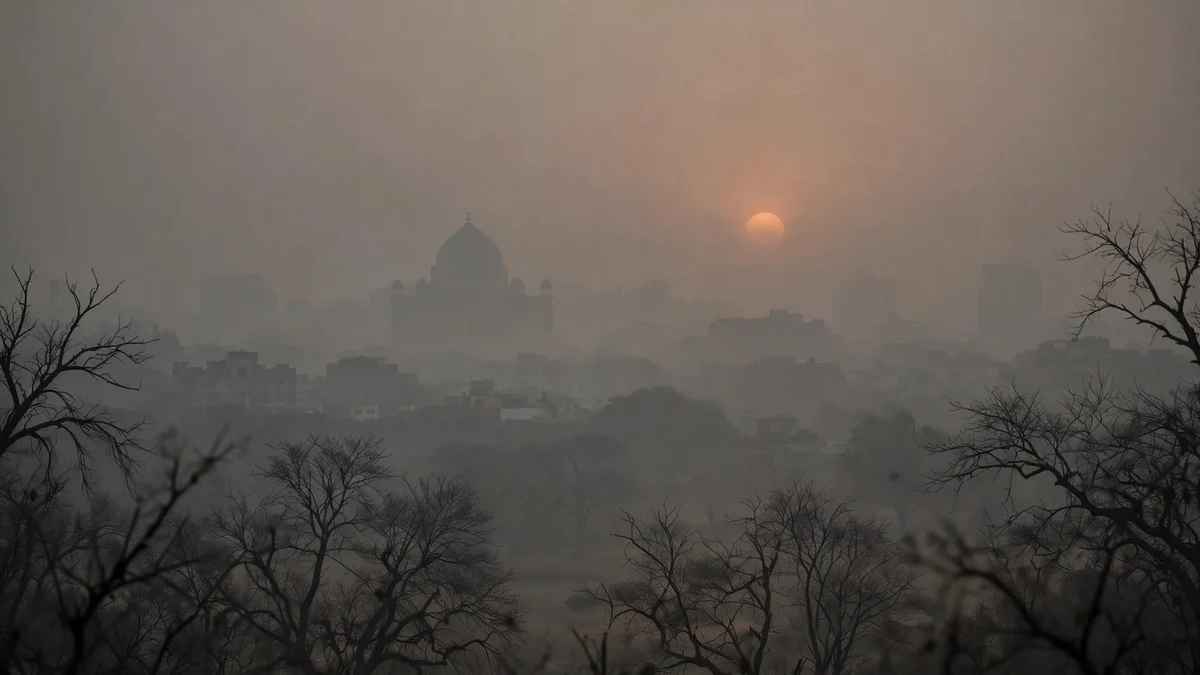
Delhi woke to an average Air Quality Index of 242 at 7 AM on Tuesday, 24 November 2026, down from 248 on Monday. The air stays in the poor band, and 10 of the city’s 57 monitoring stations were already very poor. Today is Guru Nanak Jayanti, so banks and stock markets are shut. The smog is not taking the day off.
Updated: 24 November 2026, 10:45 IST
Quick Read
- Delhi’s average AQI was 242 at 7 AM on Tuesday, 24 November 2026, down 6 points from 248 on Monday, and still in the poor band (201 to 300).
- Of 57 monitoring stations with valid readings, 46 were above 200 and 10 were above 300, in the very poor band. Sirifort was worst at 336.
- The Air Quality Early Warning System expects poor air on Tuesday and Wednesday, then very poor air on Thursday, 26 November.
Delhi’s air was poor again on Tuesday morning. The city’s average Air Quality Index (AQI) stood at 242 at 7 AM on 24 November 2026, according to real-time data from the Central Pollution Control Board (CPCB), as reported by The S Bharat. That is 6 points lower than the 248 recorded at the same time on Monday. It is a small move in the right direction, and it is not enough to change the band. An AQI from 201 to 300 counts as poor on the CPCB scale. Delhi has now spent six straight mornings in that band.
Today is Guru Nanak Jayanti, also called Prakash Gurpurb Sri Guru Nanak Dev. Banks are shut in most of the country, and the NSE and BSE are closed for the day. Schools and offices are quieter than usual. But the smog does not follow the holiday calendar. The same fine dust that filled the air on Monday is still there on Tuesday, and the forecast says it will get worse before it gets better.
The morning number, station by station
The city average hides wide gaps between areas. Of the 57 monitoring stations in Delhi with valid readings at 7 AM, 46 recorded AQI levels above 200, which puts them in the poor band. Ten stations went further, crossing 300 into the very poor band. Eleven stations sat in the moderate band, between 101 and 200. So a short drive across the city on Tuesday morning could take you from moderate air to very poor air.
Sirifort was the worst of the listed stations, at 336. IGNOU Maidan Garhi followed at 333, and North Campus at 322. IIT Delhi recorded 302, and ITO stood at 306. Talkatora Garden, CRRI Mathura Road, Burari Crossing and the Commonwealth Sports Complex were also above 300 in the morning readings. At the other end, IGI Airport recorded 191, in the moderate band. Anand Vihar stood at 207, and Burari at 250. Chandni Chowk recorded 265.
By 8 AM, the city average had eased to 200, according to IANS data carried by Vividh Bharathi, with Sirifort still worst at 333. That one-hour shift shows how fast the morning number can move as the sun rises and the air starts to mix. It also shows why a single reading should never be read as the whole day. The 7 AM average is the fixed point this desk uses every day, because it is the same clock time as yesterday’s 248 and the day before’s 236. On that like-for-like basis, the air improved a little.
PM2.5 stayed the main pollutant. PM2.5 means tiny dust particles, less than 2.5 microns wide, small enough to pass deep into the lungs. They come from vehicles, burning, dust and industry. When PM2.5 drives the AQI, the number tracks these tiny particles more than any other pollutant.
Six mornings in a row in the poor band
The 7 AM series now reads 286, 270, 279, 236, 248 and 242, from 19 November to today. That is six mornings in the poor band, with the worst morning, 286, now five days behind us. The last two days have been the mildest of the six, at 248 and 242. The gap from the peak is 44 points. The direction is down, but the pace is slow, and every one of those six mornings still counts as poor air.
| Date | 7 AM AQI | Band | Change vs previous day |
|---|---|---|---|
| Thu 19 Nov 2026 | 286 | Poor | — |
| Fri 20 Nov 2026 | 270 | Poor | −16 |
| Sat 21 Nov 2026 | 279 | Poor | +9 |
| Sun 22 Nov 2026 | 236 | Poor | −43 |
| Mon 23 Nov 2026 | 248 | Poor | +12 |
| Tue 24 Nov 2026 | 242 | Poor | −6 |
The table shows a pattern, not a trend. The number fell, rose, fell hard, rose a little, and fell a little. That is what winter air in Delhi does when the wind is weak and the nights are cold. A single day’s fall proves nothing on its own. Three of the last four mornings were better than the three before them, and that is the most that can be said so far.
Also read: Delhi AQI 248 Air Stays Poor as Fog Lingers
Two scales, two numbers: why weather.com says 241
Readers who check weather.com will see a different number. At about 10:30 AM on Tuesday, weather.com showed Delhi at 241 on its own scale, marked “Very Unhealthy”, with PM2.5 as the main pollutant, fog, 65°F and humidity at 65%. Earlier in the morning it had read 244. That number is not the CPCB figure, and it should never be quoted as one.
The two scales work in different ways. The CPCB scale runs from 0 to 500 and groups readings into six bands: good up to 50, satisfactory to 100, moderate to 200, poor to 300, very poor to 400, and severe above that. The US scale that weather.com uses has its own bands and its own maths, and its “Very Unhealthy” label covers a different range. A US-scale 241 and a CPCB 242 look close by chance. They are not the same measurement, and they can split apart by a wide margin on other days. Yesterday, for example, the CPCB 7 AM figure was 248 while weather.com’s US-scale reading stood at 361. Same city, same morning, very different numbers.
Live trackers add a third kind of number. One live tracker showed Delhi at 439 on the CPCB scale at about 9 AM, driven by an hourly PM2.5 spike at Sirifort. That is a live hourly reading, not a city average, and it jumps up and down through the day. The 7 AM city average is the steady number. The live trackers show how bad a single spot can get in a single hour. Both are real. They answer different questions.
What the forecast says next
The Air Quality Early Warning System expects Delhi’s air to stay in the poor band on Tuesday and Wednesday, then slide into the very poor band on Thursday, 26 November. The India Meteorological Department expects fog to persist, with night temperatures cooling from Wednesday. Fog matters because it traps dust close to the ground. When the air is still and damp, the tiny particles have nowhere to go.
Delhi was not the worst city in the country on Tuesday morning. Among 282 cities with valid readings in the CPCB’s 7 AM data, Panchgaon in Haryana recorded the highest AQI, at 310. Baddi in Himachal Pradesh matched Delhi at 242. In the National Capital Region, Bahadurgarh recorded 249, a touch worse than Delhi itself. The smog is a regional problem, not a Delhi-only problem, and the wind that could clear it has not arrived.
Also read: Delhi AQI 236 Air Stays Poor as Fog Lingers
A holiday for the city, not for the smog
Guru Nanak Jayanti marks the birth of Guru Nanak Dev, the founder of Sikhism. It is a public holiday across much of India. Banks are closed in 21 cities under the Reserve Bank of India’s holiday calendar, and stock trading is shut for the day on both the NSE and the BSE. The Multi Commodity Exchange will trade only in its evening session, from 5 PM. Gurdwaras will hold prayers and langar through the day, and many families will be out in the morning, when the air is at its worst.
That timing is the one thing worth flagging today. The morning is when the AQI peaks, before the sun lifts the fog. A visit to the gurdwara, a walk with children, or a morning run all land in the worst hours. The air is likely to ease a little by the afternoon as temperatures rise toward a high near 79°F, with sunny spells expected after midday. The forecast high of 79°F and low of 55°F, with no rain, gives the day a clear shape: cold, foggy and dirty in the morning, brighter and a little cleaner by the afternoon, then cold again at night.
What GRAP stages I and II still mean
The Graded Response Action Plan, or GRAP, is Delhi’s winter rulebook for bad air. Stage I and Stage II remain in force. Stage III was revoked on 17 November, when the air eased. Stage I covers the basic steps: dust control at building sites, a ban on open burning, and checks on polluting vehicles. Stage II adds more, such as a ban on diesel generator sets except for essential services, more frequent cleaning of roads, and a push to move people onto public transport.
None of those steps has cleared the air on its own, and none of them was built to. GRAP slows the build-up of dust. It does not make the wind blow. The test of the plan comes on Thursday, when the forecast points to very poor air. If the AQI crosses 300 and stays there, Stage III returns to the table. That stage brings stricter steps, including a halt to most construction work and limits on some vehicle types. For now, the city stays in Stages I and II, and the air stays poor.
How to get through the day
The health advice for a poor-air day is simple, and it has not changed. Keep outdoor exercise short, and move it to the afternoon if you can. Children, older people, and anyone with asthma or heart trouble should stay indoors in the morning hours. An N95 mask helps outdoors; a cloth mask does very little against PM2.5. Keep windows shut in the morning, and run an air purifier indoors if you have one. Drink water, and skip the morning walk on the main road, where traffic adds its own dust to the smog.
One more point matters for today. Fog and smog together cut visibility on the roads. Drivers should slow down, use fog lamps where fitted, and keep a longer gap from the vehicle ahead. The fog is expected to lift by late morning, but the early hours need care.
What to watch tomorrow
Three numbers will tell the story on Wednesday morning. The first is the 7 AM city average: if it stays near 242 or falls, the mild stretch continues. The second is the count of stations above 300: ten today, and a rise there would warn of a slide before the forecast date of Thursday. The third is the wind. A light west wind is forecast through the day, and anything stronger would help. If the average rises toward 280 and the very-poor count climbs past 15, the Thursday forecast of very poor air will look firm, and Stage III will be back in the news. For today, the fact stands: 242, poor, six mornings in a row, on a holiday the smog did not take.
FAQ
What was Delhi’s AQI today, 24 November 2026?
Delhi’s average AQI was 242 at 7 AM on Tuesday, 24 November 2026, according to CPCB data reported by The S Bharat. That is in the poor band (201 to 300), and 6 points lower than Monday’s 248 at the same time.
Why does weather.com show a different AQI for Delhi?
Weather.com uses the US AQI scale, not the CPCB scale. At about 10:30 AM it showed 241, marked “Very Unhealthy”, with PM2.5 as the main pollutant. The two scales use different maths and different bands, so their numbers are not directly comparable, even when they look close.
Will Delhi’s air get worse this week?
The Air Quality Early Warning System expects poor air on Tuesday and Wednesday, then very poor air on Thursday, 26 November. Fog is forecast to persist, with cooler nights from Wednesday. GRAP Stages I and II remain in force, and Stage III was revoked on 17 November.
Also read: Bisleri Water Fails Tests FSSAI Orders Prosecution
Sources
- The S Bharat — Delhi wakes to poor air as AQI stands at 242, NCR cities fare worse (PRIMARY: CPCB 242 at 7 AM Tue 24 Nov, vs 248 Mon; 57 stations, 46 above 200, 10 above 300; Bahadurgarh 249; Panchgaon 310 highest of 282 cities; Baddi 242): https://thesbharat.com/thesbharat9gmail-com/delhi-wakes-to-poor-air-as-aqi-stands-at-242-ncr-cities-fare-worse-india-news/ (200; 24 Nov)
- Dainik News Live — Delhi grapples with ‘poor’ air quality as AQI reaches 242, Sirifort worst affected at 336 (PRIMARY: Sirifort 336, IGNOU Maidan Garhi 333, North Campus 322, IIT Delhi 302, ITO 306; 10 very poor, 36 poor, 11 moderate stations; forecast poor Tue-Wed, very poor 26 Nov; CPCB bands): https://dainiknewslive.in/delhi-grapples-with-poor-air-quality-as-aqi-reaches-242-sirifort-worst-affected-at-336/ (200; 24 Nov)
- Vividh Bharathi (IANS) — Delhi’s air quality remains ‘poor’, multiple stations record AQI above 300 (PRIMARY: city average 200 at 8 AM; Sirifort 333 at 8 AM): https://vividhbharathi.com/delhis-air-quality-remains-poor-multiple-stations-record-aqi-above-300/ (200; 24 Nov)
- Weather.com — Delhi live weather and air quality (US scale: 241 “Very Unhealthy” at ~10:30 AM check, PM2.5 primary, fog, 65°F, humidity 65%; high 79°F, low 55°F): https://weather.com/in/dl/city/new-delhi/today (404 on curl HEAD; figures taken from live search snippet, 24 Nov)
- The Hindu BusinessLine — Domestic stock markets closed for Guru Nanak Jayanti; MCX to resume trading in evening session (NSE/BSE closed 24 Nov; MCX evening session from 5 PM): https://www.thehindubusinessline.com/markets/domestic-stock-markets-closed-for-guru-nanak-jayanti-mcx-to-resume-trading-in-evening-session/article71737090.ece (200; 24 Nov)

Sasanka Sekhar Pradhan is the founder of India Presents, an India-focused news site. He covers daily box-office trackers, India news, economy explainers, sports previews and festival guides — in simple English, so readers across India can follow fast-moving stories without jargon. His focus is what a story means for the reader: the number that matters, the source behind it, and what happens next. India Presents publishes daily, with day-trackers updated as new figures come in.