
Iran has opened the Strait of Hormuz for ships from India, China, Iraq and Qatar. Indian ships can pass freely, but the route is still a war zone — and Tehran will charge a fee.
Updated: 8 November 2026, 10:15 AM IST
Quick Read
- Iran has exempted ships from India, China, Iraq and Qatar from Strait of Hormuz curbs, a senior Iranian lawmaker said.
- In return, Iran wants medicine from India and political backing from China. Indian and Chinese ships will pay a transit fee.
- The exemption does not mean safe passage. Shipping firms are still in wait-and-watch mode, and the US blockade stays in place.
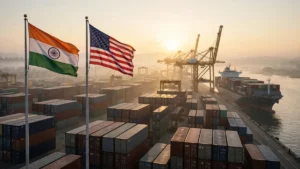
Iran has exempted ships from India, China, Iraq and Qatar from its Strait of Hormuz curbs. Amir Hayat Moqaddam, deputy chairman of the Iranian parliament’s National Security and Foreign Policy Committee, said this in an interview with the Iranian Students’ News Agency (ISNA) on Tuesday. The Times of India, The Indian Express and NDTV reported the exemption on 4 November, and Al Jazeera explained the deal in detail on 6 November. “Ships from these countries pass freely, and the Americans do not intercept them either,” Moqaddam was quoted as saying.
What Iran gets in return
Iran is not giving this away for free. It wants something from each country.
India’s part of the deal is medicine. Tehran will let Indian ships pass so it can import medicines from India. China’s part is political support. Beijing is Iran’s biggest friend in this war, and Tehran wants China to keep backing it in public. Qatar’s part is mediation. Doha is leading the talks to end the war, and Iran already gets diplomatic support from Qatar.
Tehran will also collect a transit fee from Indian and Chinese ships. Qatari ships pass free. Moqaddam did not say whether Iraqi ships will pay a toll. So “exempt” here means free to pass, not free of charge.
What is the Strait of Hormuz?
Think of it as a narrow sea gate. The Strait of Hormuz is a thin strip of water between the Persian Gulf and the Gulf of Oman. On one side sits Iran. On the other side sits Oman and the United Arab Emirates.
About 20% of the world’s oil and gas trade passes through this gate in normal times. In October, about 10.23 million barrels a day of Gulf crude passed through the strait, according to Kpler, a firm that tracks oil ships. About 42% of that oil went to China and about 13% went to India. That is why this narrow strip of water shows up in India’s fuel prices.
Iran shut the strait early in the war with the US and Israel, which began on 28 February 2026. The United States then put a naval blockade on Iran’s southern ports in July. Only a few ships were allowed through, and others faced checks and fees.
Why this matters for India’s oil bill
India buys most of its oil from the Gulf. When the strait is shut, less oil reaches the market. Less oil means higher prices. Higher prices mean a bigger import bill for India, and that pressure can reach petrol and diesel pumps.
The exemption is good news, but only if ships actually start sailing again. Oil prices have already cooled a bit. Brent crude fell 8.7% to $94.62 a barrel on 4 November, after the US midterm results. A working strait would help keep that calm.
There is a second India link. Indian seafarers work on ships across the Gulf. Attacks on shipping in the region have already claimed Indian lives, and two Indian seafarers went missing near the strait in October. Every ship that can pass safely is one less risk for an Indian crew.
Also read: Brent crude falls 8.7% as India gains | 2 ships sunk in 24 hrs — India’s oil bill at risk
The catch: free passage is not safe passage
The exemption is Iran’s word. It is not a deal with the United States. And the United States runs the blockade.
US Central Command (CENTCOM) has said its blockade applies to “all vessels of all nations entering or leaving coastal areas or ports in Iran”. Ships that avoid Iranian ports are not affected. Analysts told Al Jazeera that the main change is this: if Washington accepts it, the exemption would also cover Indian and Chinese ships sailing to and from Iran itself. That “if” is doing a lot of work.
Shipping firms are not rushing back. “We have not sent any ships since April. If our vessels and crew face no security risks, we can resume sending ships,” one Indian shipping executive told The Times of India. The industry is in wait-and-watch mode. It wants clarity before it sends crews into a war zone.
Iran also began letting some ships from friendly countries pass within weeks of the war starting. So this exemption is not the first opening. It is the first time Tehran has named the four countries in public and spelled out the price.
The war is still on
The war is in its seventh month. A ceasefire has been in place since 8 April, but the strait stayed shut and the fighting at sea never fully stopped.
On Sunday morning, Iranian state media reported blasts on Qeshm Island in the strait and in the cities of Jask, Sirik and Bandar Abbas. The US has announced a new plan to block Iran’s land supply routes, adding to its months-long naval blockade. The UAE National Guard rescued 22 people from a cargo ship that caught fire in the Gulf of Oman after Iran’s Revolutionary Guard reported two oil tankers struck mines in the strait.
There is a peace track, but it is stuck. Iran sent a seven-day roadmap to end the war through Qatar. Under it, the strait would reopen on day six and US-Iran nuclear talks would start on day seven. In return, the US would lift its naval blockade, waive oil sanctions, release about $12 billion in frozen Iranian assets and observe a regional ceasefire. Foreign Minister Abbas Araghchi laid out the plan outside the UN Security Council on Friday. The Wall Street Journal reported that President Trump rejected it. Trump is said to be privately sceptical and expects fresh bombing after the US midterm elections.
Who passes, who pays — at a glance
| Country | Can its ships pass? | What Iran gets |
|---|---|---|
| India | Yes, exempt | Medicine imports from India; transit fee |
| China | Yes, exempt | Political backing; transit fee |
| Iraq | Yes, exempt | Not stated; fee unclear |
| Qatar | Yes, exempt, free | Diplomatic support; leads mediation |
| All others | No, still restricted | — |
This table is compiled by this desk from the ISNA interview as reported by Al Jazeera and The Times of India. It is the simplest way to see the deal: four countries in, everyone else still out.
Also read: Strait of Hormuz Explained: The Narrow Waterway Behind India’s Fuel Prices
FAQ
Q: Which countries has Iran exempted from Hormuz curbs?
A: India, China, Iraq and Qatar. The exemption was announced by Amir Hayat Moqaddam, deputy chairman of the Iranian parliament’s National Security and Foreign Policy Committee, in an ISNA interview on Tuesday.
Q: Do Indian ships have to pay to cross the Strait of Hormuz?
A: Yes. Iran will collect a transit fee from Indian and Chinese ships. Only Qatari ships pass free. The exemption is about permission to pass, not a waiver of fees.
Q: Is it safe for Indian ships to sail through the strait now?
A: Not yet. The US blockade is still in place, blasts were reported in the strait area on 8 November, and Indian shipping firms say they are in wait-and-watch mode. They have not sent ships since April.
Sources
- Al Jazeera — “Why is Iran exempting India, China, Qatar, Iraq from Hormuz restrictions?” (6 Nov 2026): https://www.aljazeera.com/news/2026/11/6/why-is-iran-exempting-india-china-qatar-iraq-from-hormuz-restrictions
- The Times of India — “Iran exempts Indian vessels from Hormuz curbs, citing medicine imports” (4 Nov 2026): https://timesofindia.indiatimes.com/world/middle-east/iran-exempts-indian-vessels-from-hormuz-curbs-citing-medicine-imports/articleshow/135536843.cms
- The Indian Express — “Iran exempts ships from India, China, Iraq and Qatar from Strait of Hormuz restrictions” (4 Nov 2026): https://indianexpress.com/article/india/iran-exempts-india-china-ships-strait-of-hormuz-transit-restrictions-medicine-imports-10951007/
- Al Jazeera live blog — Iran war live, explosions in Qeshm, Jask and Bandar Abbas (8 Nov 2026): https://www.aljazeera.com/amp/news/liveblog/2026/11/8/iran-war-live-explosions-hit-qeshm-us-moves-to-block-land-supply-routes

Sasanka Sekhar Pradhan is the founder of India Presents, an India-focused news site. He covers daily box-office trackers, India news, economy explainers, sports previews and festival guides — in simple English, so readers across India can follow fast-moving stories without jargon. His focus is what a story means for the reader: the number that matters, the source behind it, and what happens next. India Presents publishes daily, with day-trackers updated as new figures come in.

Pingback: Strait of Hormuz: 5 Shocking Facts Behind Oil Prices