
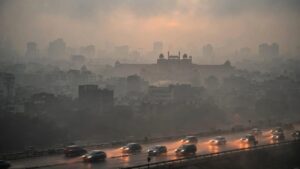
Delhi woke up to thick, grey air on Diwali morning. The city’s average AQI stood at 384 at 6 am, per the Central Pollution Control Board (CPCB). That puts the whole city in the “very poor” band. Eleven monitoring stations had already crossed 400 by 6 am. That is the “severe” band.
Updated: 8 November 2026, 10:30 AM IST
Quick Read
- Delhi’s average AQI was 384 at 6 am and 383 at 8 am on Diwali morning — “very poor”, per CPCB data.
- Jahangirpuri recorded the worst air at 450, and 11 stations crossed 400 at 6 am; by 7–8 am, 24 stations were above 400.
- GRAP Stage-III curbs have been in force since 6 November, and the air is likely to turn “severe” on 9 November.
Delhi’s worst air this Diwali morning
Jahangirpuri recorded the worst air in the city, at 450. Punjabi Bagh stood at 446–449, RK Puram at 448, Bawana at 444–446, and IIT Delhi at 443–446, per CPCB readings carried by the Indian Express and Business Standard. Rohini recorded 445. NSIT Dwarka stood at 441.
Other badly hit areas: Chandni Chowk at 420–423, Patparganj at 421, Alipur at 413, and Pusa at 415. North Campus of Delhi University recorded 423. India Gate, where many families head on Diwali evening, stood at 398. Akshardham recorded 336. Both are still “very poor”.
The count of severe stations rose fast through the morning. ABP Live, citing CPCB, reported 11 stations above 400 at 6 am. News24 and Scroll reported 24 stations above 400 by around 7–8 am. The two numbers are both right. They were taken at different times.
This morning was worse than Saturday. Delhi’s AQI was 364 at 8 am on Saturday, 7 November. The daily average for Saturday, Diwali eve, was 369. That was the most polluted Diwali eve in ten years, and the worst day-before-Diwali reading since 2016, per NewsBytes citing CPCB data.
One number we are NOT using: 483
Some readers may see a different number today. The Hindu BusinessLine and Mathrubhumi reported an overall AQI of 483 at 8:10 am, also citing CPCB. That would put the whole city in the “severe” band.
It does not match the CPCB hourly bulletin. The Indian Express, Business Standard, ABP Live and Scroll all report 383–384 for the same morning, from the same CPCB data. The 483 figure may come from a different averaging window, or from a single station read as a city average. We do not know which. So we are not using 483 as the city average. The honest number is 384.
Weather apps add to the confusion. Weather.com showed its own Delhi AQI read of 411. That is a different model, not CPCB. Do not mix the two.
What GRAP-3 means for you
The Commission for Air Quality Management (CAQM) invoked Stage III of the Graded Response Action Plan (GRAP) on Friday, 6 November. It covers Delhi-NCR — Delhi plus adjoining districts in Haryana, Uttar Pradesh and Rajasthan. It came two days before Diwali, as the air was already sliding.
Here is what Stage III does, in plain words:
- Non-essential construction work is halted across Delhi-NCR.
- BS-III petrol cars and BS-IV diesel light motor vehicles face restrictions on the roads.
- Primary-school students get hybrid learning — part online, part in class.
Delhi has other rules running alongside. The Delhi government is enforcing its annual ban (1 November to 31 January) on non-BS-VI vehicles registered in other states. From 1 November, BS-IV or older commercial goods vehicles and buses cannot enter Delhi at all.
Also read: Delhi AQI 369 on Dhanteras: very poor air before Diwali
Green crackers tonight: only 8 to 10 pm
The Supreme Court’s order of 29 October allows only green crackers in Delhi-NCR, and only in two windows: 6–7 am and 8–10 pm, on 7 and 8 November. Tonight, that means 8–10 pm only. The full cracker ban comes back on 9 November.
Only CSIR-NEERI-approved green crackers can be sold or burst. Each box must carry a QR code with the maker, the NEERI registration, the licence and the test certificate. Joined-series crackers (ladis) are banned. So is barium. So are normal crackers. No crackers are allowed within 300 metres of hospitals, nursing homes, health centres, old-age homes, schools or notified silence zones.
One warning: a Deccan Herald version of the timings (“6 am–8 pm on 7 Nov; 7 am–10 pm on 8 Nov”) conflicts with four other sources — Bar & Bench, Business Today, The Statesman and Business Standard. Do not follow it. The correct windows are 6–7 am and 8–10 pm.
Why the air is this bad
Three things came together. Farm fires, still air, and the festival itself.
ISRO’s INSAT-3DS satellite picked up 415 fire pixels in Punjab and Haryana on Saturday. PM2.5 in Delhi’s residential areas spiked above 600, per NewsBytes.
Delhi’s weather is not helping. The city was 22°C at about 9:30 am, with a high of 29°C and a low of 18°C. Skies are partly cloudy. Wind is from the south-east at about 9 km/h. Light wind means the haze sits over the city instead of blowing away.
Also read: Delhi green firecrackers: timings, QR check and the 300-metre rule
What happens tomorrow
The news is not good. The Air Quality Early Warning System for Delhi says the AQI is likely to be “severe” on 8 and 9 November, then “very poor” for the six days after that. IITM, the Pune weather institute, predicts the AQI could worsen to 406 by Monday morning.
Monday, 9 November, will be mostly sunny, with a high of 28°C and a low of 17°C. Rain chance is 10%.
If you step out tonight for Lakshmi Puja or to meet family, wear a mask if you have one. Keep children and older people indoors as much as you can. If anyone at home has asthma or a heart problem, keep their medicines close.
Delhi AQI, day by day — our own count
| Day | Delhi average AQI | Worst station | What it means |
|---|---|---|---|
| Tue 3 Nov | 330 (8 am) | Jahangirpuri 451 | Very poor |
| Sat 7 Nov | 364 (8 am) | IIT Delhi 443 | Very poor |
| Sun 8 Nov | 384 (6 am) | Jahangirpuri 450 | Very poor, 11 stations severe |
This table is our own count, put together from CPCB readings carried by the Indian Express, Business Standard, ABP Live and Business Today. Two things stand out. First, the city average has climbed every day this week. Second, the worst station has stayed above 440 for five days. This is not a one-morning spike. It is a slow build-up, and Diwali night will add to it.
The CPCB bands, for reference: 0–50 is good, 51–100 satisfactory, 101–200 moderate, 201–300 poor, 301–400 very poor, 401–500 severe. At 384, Delhi sits 16 points below “severe”. One bad evening of crackers can push it over.
FAQ
Q: What is Delhi’s AQI today, 8 November 2026?
A: Delhi’s average AQI was 384 at 6 am and 383 at 8 am on Diwali morning, per CPCB data. That is “very poor”. Jahangirpuri was worst at 450, in the “severe” band.
Q: What is GRAP-3 and what does it change in Delhi?
A: GRAP Stage III is the third level of Delhi-NCR’s graded pollution plan, invoked by CAQM on 6 November. It halts non-essential construction, restricts BS-III petrol and BS-IV diesel light vehicles, and brings hybrid learning for primary-school students.
Q: When can I burst green crackers in Delhi today?
A: Only between 8 pm and 10 pm tonight, 8 November. The morning window (6–7 am) has passed. Only CSIR-NEERI-approved green crackers are allowed, and the full ban returns on 9 November.
Also read
- Delhi AQI 369 on Dhanteras: very poor air before Diwali
- Delhi green firecrackers: timings, QR check and the 300-metre rule
- Delhi winter smog 2026: how to protect your family this winter
Sources
- ABP Live — Delhi AQI 384, 11 stations severe, GRAP Stage 3 (primary source for the headline figure): https://news.abplive.com/cities/delhi-aqi-384-diwali-11-monitoring-stations-severe-grap-stage-3-1875155/amp
- Business Standard — Delhi AQI 383 at 8 am, station readings: https://www.business-standard.com/india-news/delhi-air-remains-very-poor-on-diwali-several-stations-record-severe-aqi-126110800090_1.html
- Indian Express — Delhi AQI 384, Jahangirpuri 450, station list: https://indianexpress.com/article/cities/delhi/delhi-aqi-diwali-morning-cpcb-pollution-jahangirpuri-pm25-reading-10955239/
- Scroll — AQI 383 at 8 am, 24 stations above 400: https://scroll.in/latest/1096952/delhi-air-quality-remains-very-poor-on-diwali-morning-several-areas-record-severe-aqi
- News24 — AQI 384 at 7 am, severe forecast for 8–9 Nov: https://news24online.com/cities/delhi-ncr/delhi-air-pollution-city-chokes-on-toxic-air-on-diwali-as-aqi-crosses-400-in-24-stations-check-imd-weather-forecast-for-next-2-days/951812/
- Bar & Bench — Supreme Court green-cracker order, timings and QR rule: https://www.barandbench.com/news/litigation/diwali-2026-supreme-court-allows-bursting-of-green-crackers-in-delhi-ncr-on-november-7-and-8

Sasanka Sekhar Pradhan is the founder of India Presents, an India-focused news site. He covers daily box-office trackers, India news, economy explainers, sports previews and festival guides — in simple English, so readers across India can follow fast-moving stories without jargon. His focus is what a story means for the reader: the number that matters, the source behind it, and what happens next. India Presents publishes daily, with day-trackers updated as new figures come in.


Pingback: Delhi GRAP-3: AQI 365, SC blames vehicles