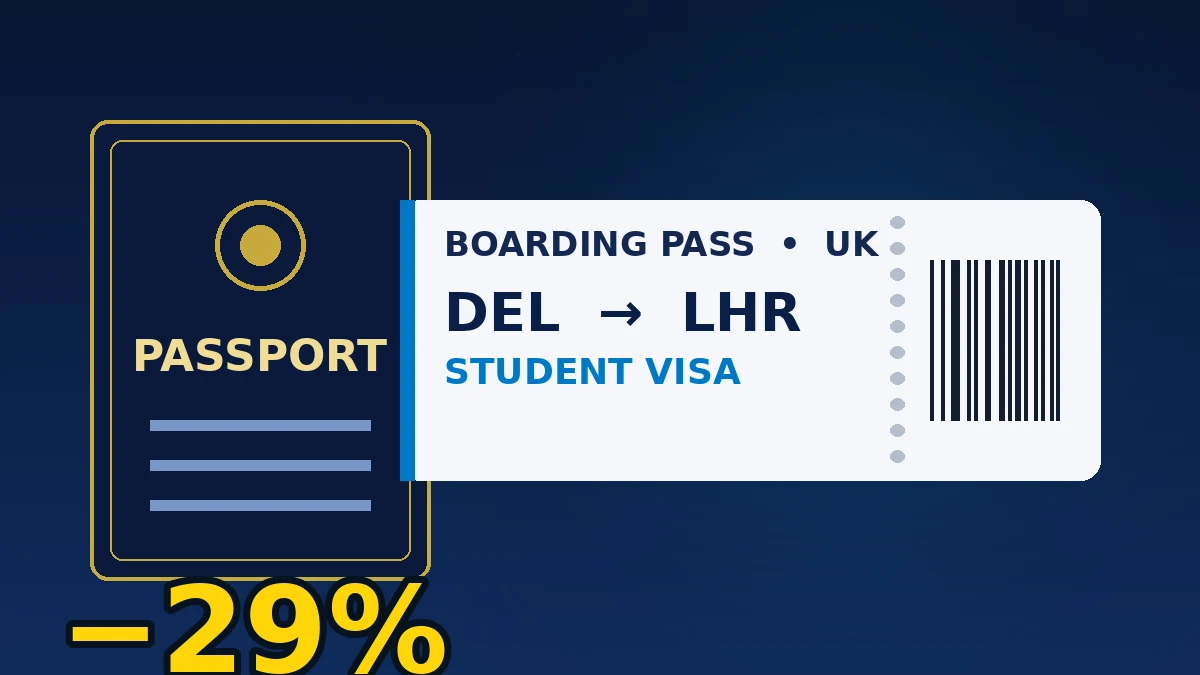
UK study visas granted to Indian students fell 29% to 69,855 in the year to September 2026, as the refusal rate hit a 10-year high and withdrawals rose.
Updated: 28 November 2026, 09:55 IST
Quick Read
- UK study visas granted to Indian students fell 29% to 69,855 in the year ending September 2026, according to Home Office data published on 26 November 2026.
- The refusal rate for sponsored study visas hit 6.4%, the highest since September 2015, and 3,682 students withdrew their applications in July to September 2026.
- Master’s-level visas fell 29% to 181,920, and Graduate route extensions fell 31% to 162,881.
The headline numbers
The UK granted 69,855 sponsored study visas to Indian students in the year ending September 2026. That is 29% fewer than the year before, according to UK Home Office figures published on 26 November 2026. India is still the second-biggest source of students for the UK, after China, which received 80,932 visas. India’s share of all sponsored study visas was 22%, the Home Office said.
The fall is part of a wider slide. The UK granted 335,801 sponsored study visas in the year to September 2026. That is down 23% on the year before — and 49% below the peak in the year ending June 2023. Put simply, the UK is now handing out about half as many student visas as it did at the peak, just three years ago.
Worked back from the 29% fall, last year’s figure for India was about 98,000. That means roughly 28,500 fewer Indian students got a UK study visa this year than the year before. (Desk estimate: 69,855 ÷ 0.71 ≈ 98,400.) The Home Office release itself gives the percentage fall, not last year’s number — the estimate above is our own maths, not a Home Office figure.
What the words mean
A “sponsored study visa” is a visa to study in the UK with the backing of a UK university or college. The university sponsors the student — it tells the Home Office the student has a real place on a real course. Without that backing, there is no visa to give.
A “main applicant” is the student himself or herself — not a husband, wife or child who travels along. The 69,855 figure counts students only. Family members who come with them are counted apart. And the “refusal rate” is the share of applications that get a “no”. A rate of 6% means about 6 in every 100 applications are turned down.
Refusals at a 10-year high
Refusals have shot up. The rolling refusal rate for UK sponsored study visas reached 6.4% in the year ending September 2026, the highest since September 2015. A year earlier it was 3.1%. The rate has more than doubled in twelve months, according to an analysis of Home Office data by Higher Insights and The Admit, reported by The PIE News.
Students are also giving up before a decision is made. In July to September 2026, 3,682 people withdrew their applications before the Home Office decided them. In the same three months of 2025, the number was 779 — a rise of 370%. The data does not say why each person withdrew. Some may have changed their plans. Some may have feared a refusal and pulled out first. But the jump is sharp, and it came in the autumn, when most students apply.
Also read: JEE Main correction window 2027: dates and how to fix errors
Who is hit hardest
The pain is not shared evenly. India’s own refusal rate is 6% — high for India, but far below some other countries. Students from Ghana face a 32% refusal rate. Pakistan is at 31%, Bangladesh at 24% and Nigeria at 19%. At the other end, students from China, the US, Hong Kong and South Korea are refused less than 1% of the time. The gap between the highest and lowest rates is huge.
| Country or region | Student visa refusal rate |
|---|---|
| Ghana | 32% |
| Pakistan | 31% |
| Bangladesh | 24% |
| Nigeria | 19% |
| India | 6% |
| China, US, Hong Kong, South Korea | Under 1% each |
Grants have fallen for other big source countries too. Pakistan is down 72%, Nigeria down 34% and Nepal down 22%, the Home Office said. India’s 29% fall sits in the middle of that list — bad, but not the worst. What sets India apart is size: even after the fall, India is still the UK’s second-largest source of students, so the drop hits more families than the bigger percentage falls elsewhere.
Master’s courses take the biggest hit
Most Indian students in the UK go for a master’s degree — a one-year course taken after a bachelor’s degree. That is where the fall is sharpest. The UK granted 181,920 visas for master’s-level courses in the year to September 2026, down 29% on the year. That is 42% below the peak of 314,929 in the year ending September 2023.
Master’s courses now make up 58% of all sponsored study visa grants, down from 63% a year earlier. The one-year master’s was the main route for Indian students — cheaper than a three-year degree, and a fast path to the Graduate route work visa. As that route narrows, fewer students see the UK as worth the cost.
The squeeze carries on after the course ends too. Extensions under the Graduate route — the post-study work visa that lets students stay and work after they finish — fell 31% to 162,881. Indians were still the largest group, with 66,552 extensions, ahead of Pakistan (24,768) and Nigeria (20,478).
Also read: UGC NET December 2026 schedule: exam dates and admit card
Why this is happening
Reports point to tighter rules for universities. Under new Home Office guidance from June 2026, a university must keep its student visa refusal rate below 5% and its course enrolment rate at or above 95%, or it risks losing the right to sponsor students. The Home Office has said that strict checks on whether applicants are genuine, and the extra duty on universities to take only genuine students, have led some universities to cut back on sponsorship in several countries.
That is the reported cause, not a guess. The Home Office also notes that international student numbers are falling overall. So the drop in Indian visas is a mix of fewer students applying, stricter checks, and universities playing safe. No single reason explains the whole 29%.
What happens next
The next test is the January intake. Students who plan to start a UK course in January should check three things before they apply: that their university still holds a sponsor licence, that their funds and papers are in order, and that the course details match what the university sent the Home Office. A small error can now cost a place — or a visa.
Students should also ask their university what its own refusal rate looks like, and whether it is still sponsoring students from India for their course. A university close to the 5% limit may turn away borderline cases it would once have backed. And anyone refused should read the refusal letter line by line — the reason given there decides what, if anything, can be fixed in a fresh application.
The next set of Home Office figures, for the year ending December 2026, will show whether the January intake steadies the fall — or the slide goes on.
Also read: Haj 2027: India quota of 1,75,025 and full application guide
FAQ
How many UK study visas did Indian students get?
69,855 sponsored study visas were granted to Indian main applicants in the year ending September 2026, down 29% on the year before, according to the UK Home Office. India stayed the second-largest source of students, after China.
Why are UK student visa refusals so high now?
The rolling refusal rate reached 6.4% in the year ending September 2026, the highest since September 2015 and more than double the 3.1% of a year earlier. Reports point to stricter university sponsorship checks: since June 2026, universities must keep their visa refusal rate below 5% and enrolment at or above 95%.
What should January intake applicants check before applying?
Check that the university still holds a sponsor licence, that funds and papers are in order, and that course details match what the university sent the Home Office. Ask the university whether it is still sponsoring students from India for that course — and if refused, read the refusal letter line by line before applying again.
Sources
- GOV.UK — Home Office, Immigration system statistics, year ending September 2026: Why do people come to the UK? Study (primary source)
- India Today — UK student visa 2026: Indian grants fall 29%, refusal rate hits 10-year high
- Edufabtech — UK student visa grants fall, refusal rate decade-high 2026
- The CSR Journal — Indian students’ UK visa grants drop 29% amid high refusals

Sasanka Sekhar Pradhan is the founder of India Presents, an India-focused news site. He covers daily box-office trackers, India news, economy explainers, sports previews and festival guides — in simple English, so readers across India can follow fast-moving stories without jargon. His focus is what a story means for the reader: the number that matters, the source behind it, and what happens next. India Presents publishes daily, with day-trackers updated as new figures come in.