India has announced a Rs 15,000 crore development package for Nepal, after Prime Minister Balendra Shah’s talks with Prime Minister Narendra Modi in New Delhi on Monday, 23 November 2026. The package is smaller than the roughly $2 billion Nepal had asked for. The two leaders also flagged off a new train between Ayodhya and Janakpur Dham, signed eight agreements, and adopted a joint vision for the partnership.
Updated: 24 November 2026, 11:00 IST
Quick Read
- India will give Nepal INR 15,000 crore (NPR 24,000 crore, about $1.62 billion): INR 3,500 crore in grants and INR 11,500 crore as a rupee line of credit for energy projects.
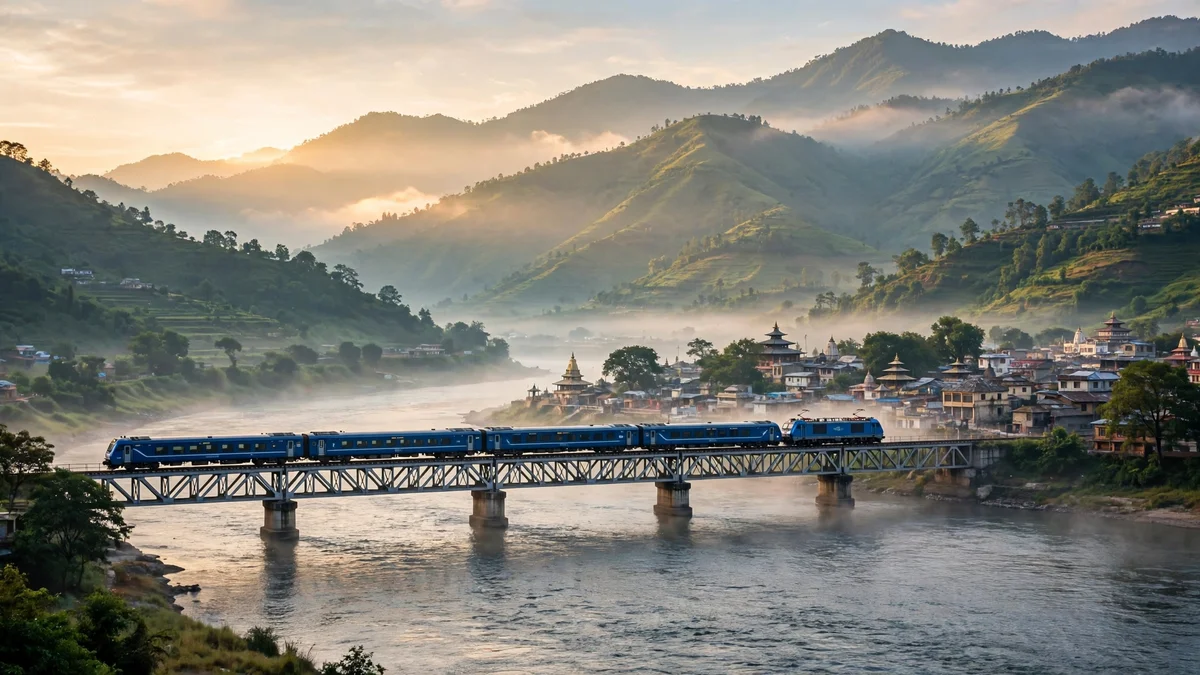
- The Saryu-Kamala Express between Ayodhya and Janakpur Dham, about 604 km in about 19 hours, was flagged off virtually, with weekly services both ways from 28 November.
- Eight MoUs were signed, covering space, policing and forensics, health and Ayurveda, urban planning, civil service training, and livestock and fisheries.
Nepal went to New Delhi asking for about $2 billion in help. It came home with about $1.62 billion. After delegation-level talks at Hyderabad House on Monday, 23 November 2026, Prime Minister Narendra Modi announced a development cooperation package of INR 15,000 crore for Nepal, equal to NPR 24,000 crore. The two governments then set it out in full in a 24-point joint press statement, and India’s Ministry of External Affairs listed 19 outcomes from the visit. The money is real, the split is now official, and the fine print matters: this is not a cash transfer, and no list of projects exists yet.
The visit was Prime Minister Balendra Shah’s first to India since he took office in March 2026. It was also short. What began as a three-day plan was cut to about 25 hours, and Shah flew back to Kathmandu on Monday afternoon. In that short window, the two sides covered money, trains, power lines, ports, and a new vision document for the whole relationship. The border dispute over Limpiyadhura, Lipulekh and Kalapani was not settled, and the statement does not claim otherwise.
The money, in numbers
The package splits into two parts. The grant is INR 3,500 crore (NPR 5,600 crore), for post-disaster reconstruction and new infrastructure projects. The rest, INR 11,500 crore (NPR 18,400 crore), comes as a rupee-denominated line of credit, for projects in the energy sector. A line of credit is a loan with agreed terms, not a gift. So just under a quarter of the package, about 23%, is grant money. The rest is credit that Nepal will repay.
The grant answers a real disaster. In August, floods in the Rasuwa-Bhotekoshi region killed around 1,500 people, with more than 5,200 still missing and presumed dead, according to JagranJosh. Homes, roads and bridges were washed away. Shah thanked India for its humanitarian and technical help after the floods, and Modi said the aid would help affected families rebuild their lives and make Nepal better able to face the next disaster.
One warning is needed. Some reports put a much bigger figure on the package. One outlet’s “$2.88 billion” is wrong maths, and this desk does not use it. The official figure is INR 15,000 crore, about $1.62 billion at the exchange rate used in international reporting. The gap between what Nepal asked for, about $2 billion, and what it got, about $1.62 billion, is close to $400 million. That gap is the first fact of this visit.
| Part of the package | Indian rupees | Nepalese rupees | What it is for |
|---|---|---|---|
| Grant | INR 3,500 crore | NPR 5,600 crore | Post-disaster reconstruction and new infrastructure |
| Rupee line of credit | INR 11,500 crore | NPR 18,400 crore | Energy sector projects |
| Total package | INR 15,000 crore | NPR 24,000 crore | About $1.62 billion |
| What Nepal had asked for | About INR 18,400 crore | About NPR 29,500 crore | About $2 billion |
Also read: Modi Nepal PM Shah Hold Talks in Delhi Today
Not a blank cheque
The joint statement is plain about how the money will move. It says the “specific projects as well as modalities” of the package “will be finalized through mutual consultations”. In plain words, the two governments have agreed on the size of the pot and the split between grant and credit. They have not yet agreed on which projects the money will fund, or on the terms for each one. No project-by-project list exists yet, and any report that prints one is inventing it.
That is normal for a deal of this kind, and it is also the reason the package should not be read as money already in Nepal’s hands. The grant for reconstruction will move first, because the need is urgent and the projects are easy to name: homes, roads and bridges lost in the floods. The energy credit will move more slowly, because power projects take years to plan and build. The test of this package will come in the months ahead, when the first project list is agreed and the first funds are released.
The train to Janakpur
The most visible outcome of the visit was a train. The two prime ministers virtually flagged off the Saryu-Kamala Express, linking Ayodhya in Uttar Pradesh with Janakpur Dham in Nepal. The journey covers about 604 km and takes about 19 hours. Regular weekly services in both directions are set to begin on 28 November.
The name needs a note. The Ministry of External Affairs list spells it “Sarayu-Kamala Express”, while JagranJosh and other Indian reports spell it “Saryu-Kamala Express”. This post uses the Saryu spelling, which matches the river’s common spelling in Indian reporting, but readers may see both forms. The train itself is the same either way.
The route runs along the Ramayana Circuit, the chain of holy sites linked to the Ramayana, and both leaders said it would boost religious and cultural tourism. Janakpur is believed to be the birthplace of Sita, and Ayodhya is the birthplace of Ram. A direct train between the two cities is a real step for pilgrims, who now face a long road journey or a flight and a drive. The two sides also agreed to explore similar links for Buddhist and Shiva-Shakti religious tourism circuits.
Rail did not stop with one train. The Final Location Survey for the Raxaul-Kathmandu electrified broad-gauge railway was finalised, which moves that long-planned line one step closer to building. On the roads, a new motorable bridge over the Mahakali river between Dharchula in India and Darchula in Nepal was inaugurated. The foundation stone was laid for a new Integrated Check Post at Banbasa, with progress noted on the check posts at Bhairahawa, Sunauli and Dodhara Chandani.
Power, pipes and ports
Energy was the second big theme, and it is where most of the credit money will go. The foundation stone was laid for the 669 MW Lower Arun Hydroelectric Project. Work on the Arun-3 project will stay on time, the statement says. India also agreed to import 10,000 MW of power from Nepal by 2030, against about 1,200 MW today, and approved 350 MW of winter power imports. Two new transmission lines, Inaruwa-New Purnea and Dodhara-Bareilly, will carry that power across the border.
Fuel moved too. Phase II of the Motihari-Amlekhgunj petroleum pipeline was dedicated to the people of Nepal, and the foundation stone was laid for the Jhapa petroleum terminal, fed by the Siliguri-Jhapa pipeline. Pipelines matter because Nepal imports all of its fuel, and a pipeline is cheaper and steadier than trucks on mountain roads.
Trade got two new doors. Nepal will get access to Deendayal Port at Kandla in Gujarat, and to Paradip Port in Odisha once the needed infrastructure is ready. Nepal is landlocked, so every extra port is a real gain: it gives Nepali exporters and importers another route to the sea, and another option when one route is blocked or crowded.
Air links moved as well. The existing one-way B345 air route from Kathmandu through Bhairahawa to Lucknow will be made two-way, which should ease flights into Nepal from India. The two sides also agreed to keep talking about other civil aviation proposals each side has put forward.
Eight agreements, from space to fish
Eight memorandums of understanding were exchanged during the visit. They cover a wide spread of subjects, and each one is a promise to work together, not a finished project. The list is: space communications, security and policing and forensics, healthcare, Ayurveda and traditional medicine, sustainable urban planning, civil service training, and livestock and fisheries.
A few of them have clear next steps. On space, ISRO and Nepal’s Ministry of Information and Communication will work on a satellite communication network using the South Asia Satellite, with a ground station and 300 user terminals in Nepal, using 36 MHz of bandwidth given free, for telemedicine, tele-education, disaster management and VSAT services. On security, India’s National Forensic Sciences University will work with Nepal Police, and the Rashtriya Raksha University will work with Nepal’s National Police Academy. On health, the two sides will work together on medicine, Ayurveda and traditional systems of treatment.
Education got the headline item. India agreed to set up an offshore campus of the Indian Institute of Technology (IIT) in Nepal, the third such campus abroad after Zanzibar and Abu Dhabi. A start-up incubator, an innovation hub, scholarships and an agro-industrial park in Chitwan were also agreed. The IIT campus is the longest-term item on the list: it will take years to build, but it would give Nepali students access to one of India’s best-known technical institutes without leaving home.
Also read: Nepal PM Shah Arrives in Delhi for Modi Talks
The joint vision, and the name question
The two leaders adopted a Joint Vision document, and its exact title is worth getting right. The 24-point joint press statement, published by Radio Nepal from Nepal’s Ministry of Foreign Affairs, gives it as “Viksit Bharat and Samunnat Nepal”. That is the official title, and this post uses it. Some reports before the visit had called it “Samriddha Nepal, Samunnat Bharat”. That form did not survive the talks. The joint vision is described as a roadmap for the partnership, covering economic development, connectivity, energy and water resources, climate resilience, disaster management, digital technology, space, innovation and cultural exchanges.
Modi accepted Shah’s invitation to visit Nepal, with dates to be fixed through diplomatic channels. A monitoring group will meet every six months to track progress on the agreed items. That six-month check is the mechanism that will show whether the package and the projects move from paper to ground.
What was not settled
The border dispute was not settled. Limpiyadhura, Lipulekh and Kalapani, the areas Nepal claims and India administers, were not resolved in the talks, and the joint statement does not claim a breakthrough. That dispute has outlasted many visits, and this one was no exception. It remains the hardest item in the relationship, and it will need a separate negotiation.
Two small flags for readers. First, the spelling of Nepal’s foreign minister: Nepal’s Ministry of Foreign Affairs and Radio Nepal give it as Shisir Khanal, while IANS reports it as Shishir Khanal. This post uses Shisir, the spelling in the official Nepali release. Second, the visit’s own shape: a state visit cut from three days to about 25 hours. That short stay still produced a package, a train, eight agreements and a vision document. The work of turning them into roads, wires and classrooms now falls to officials on both sides, meeting every six months to check progress.
FAQ
How big is the India-Nepal package, and what is the split?
The package is INR 15,000 crore, equal to NPR 24,000 crore or about $1.62 billion. It splits into INR 3,500 crore in grants for post-disaster reconstruction and new infrastructure, and INR 11,500 crore as a rupee-denominated line of credit for energy projects. It is less than the roughly $2 billion Nepal had asked for.
When does the Ayodhya-Janakpur train start?
The Saryu-Kamala Express was flagged off virtually by the two prime ministers on 23 November 2026. The journey between Ayodhya and Janakpur Dham covers about 604 km in about 19 hours, and regular weekly services in both directions are set to begin on 28 November.
Is the Rs 15,000 crore a cash payment to Nepal?
No. The joint statement says the specific projects and the way the money is given will be finalised through mutual consultations. No project list exists yet, and no money moves until projects are agreed. The grant part will fund reconstruction and infrastructure, and the credit part will fund energy projects.
Also read: Look at India Trump Cites 7 Percent Growth Hits Fed
Sources
- Radio Nepal — Joint Press Release: State visit of PM Shah to India reinforces bilateral ties, cooperation (PRIMARY: full 24-point joint press statement from Nepal MoFA; INR 15,000 cr = NPR 24,000 cr; grant INR 3,500 cr, LoC INR 11,500 cr; Joint Vision “Viksit Bharat and Samunnat Nepal”; Rasuwa-Bhotekoshi floods): https://radionepalonline.com/en/2026/11/23/439151.html (200; 23 Nov)
- JagranJosh — PM Modi Meets Nepal PM Balen Shah: Check Key Takeaways From Rs 15,000-Crore Package to 8 Deals (PRIMARY: $1.62bn; floods killed ~1,500, 5,200+ missing; 8 MoUs listed; Saryu-Kamala Express 604 km, ~19 hrs, weekly from 28 Nov; IIT campus): https://www.jagranjosh.com/lite/general-knowledge/pm-modi-meets-nepal-pm-balen-shah-check-key-takeaways-aid-package-8-pacts-iit-ayodhyajanakpur-train-1820014072-1 (200; 23 Nov)
- Hamro Niti — Balen Shah India Visit Outcomes: 8 Deals Nepal Got (24-point statement analysis; ~25-hour visit cut from 3-day plan; $2bn ask vs $1.62bn deal; no project list yet): https://hamroniti.com/balen-shah-india-visit-outcomes/ (200; 23 Nov)
- Virginia Times — Modi, Nepal PM Shah Unveil 19 Outcomes, Rs 15,000 Crore Package (MEA 19-outcome list; Sarayu-Kamala spelling; satellite ground station + 300 terminals, 36 MHz free; B345 air route; 10,000 MW target): https://virginiatimesnow.com/modi-nepal-pm-shah-19-outcomes-delhi-talks/ (406 on curl HEAD; figures used only where corroborated by Radio Nepal and JagranJosh above; 23 Nov)
- Indian Republic — India-Nepal Rs 15,000 crore package, Modi-Balendra Shah joint vision (package split and joint vision coverage): https://www.indianrepublic.in/2026/11/india-nepal-15000-crore-package-modi-balendra-shah-joint-vision.html (200; 23 Nov)
- DailyGKUpdate — Daily Current Affairs 24 November 2026 (visit outcomes summary): https://dailygkupdate.in/daily-current-affairs-24-november-2026-india-nepal-qbuse-sampada-ashank/ (200; 24 Nov)

Sasanka Sekhar Pradhan is the founder of India Presents, an India-focused news site. He covers daily box-office trackers, India news, economy explainers, sports previews and festival guides — in simple English, so readers across India can follow fast-moving stories without jargon. His focus is what a story means for the reader: the number that matters, the source behind it, and what happens next. India Presents publishes daily, with day-trackers updated as new figures come in.