
Delhi’s air quality index stood at 279 at 7 AM today, per the Central Pollution Control Board, in the poor range.
By 8:20 AM it had climbed to 327, very poor, as fog and weak winds held pollution close to the ground.
Updated: 21 November 2026, 10:05 IST
Quick Read
- Delhi’s overall AQI was 279 at 7 AM today, per CPCB, in the poor category; by 8:20 AM it had risen to 327, very poor, per IANS.
- AIIMS recorded 369 and Chandni Chowk 365 in the morning, both very poor; PM2.5 is the main pollutant.
- GRAP Stage I and II measures stay in force; Stage III was revoked on 17 November. Fog and haze cut visibility in the morning.
Delhi woke to poor air again on Saturday. The city’s overall air quality index stood at 279 at 7 AM today, according to the Central Pollution Control Board (CPCB), the Indian Economic Observer reports from CPCB’s live data. That puts the air in the poor range. But the number did not stay there: by 8:20 AM it had climbed to 327, which is very poor, per IANS.
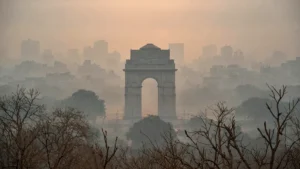
That climb inside a single morning is the story of the day. The air is not stuck at one number. It moves with the fog, the wind and the cold, and this morning all three worked against Delhi. Fog and haze cut visibility in several parts of the city in the morning hours, and weak winds gave the pollution nowhere to go.
What the stations say
The city-wide number hides wide gaps between areas. Among the monitoring stations, AIIMS recorded an AQI of 369 and Chandni Chowk 365 in the morning, both in the very poor range, per the CPCB data carried by the Indian Economic Observer. Wazirpur recorded 332, Anand Vihar 327, IIT Delhi 308 and Bawana 304, all very poor.
The IANS report, filed a little later in the morning, puts the worst stations higher still: Sirifort at 368, Chandni Chowk at 366, the Commonwealth Sports Complex at 362, Punjabi Bagh at 360, CRRI Mathura Road at 355 and Pusa at 353. The two reports agree on the picture even where the exact station numbers differ: several parts of the city are in very poor air while the city average sits at the top edge of poor.
PM2.5 is the main pollutant, as it was yesterday. PM2.5 means tiny dust particles, less than 2.5 microns across, small enough to get deep into the lungs. When PM2.5 leads the reading, the haze you see is mostly these fine particles, from vehicles, dust, smoke and burning.
For scale, here is the CPCB ladder: 0 to 50 is good, 51 to 100 is satisfactory, 101 to 200 is moderate, 201 to 300 is poor, 301 to 400 is very poor, and 401 to 500 is severe. At 279, Delhi sits near the top of poor. At 327, it has crossed into very poor. The line between the two is 300, and Delhi crossed it during the morning.
Also read: Delhi AQI 270: air stays poor today
Yesterday, and why today is worse
Friday was poor too, but a little better. Delhi’s air stayed in the poor range for the sixth straight day on Friday, with the AQI at 268 around noon and settling at 270 by 4 PM, per the IANS report. That was a small improvement from 280 at the same time a day earlier. Several stations were already above 300 on Friday, with Siri Fort at 348, Pusa at 337 and JNU at 338, per CPCB data at 7:05 AM on Friday.
So the direction of travel is clear: 270 on Friday afternoon, 279 at 7 AM today, 327 by 8:20 AM. The air is getting worse through the morning, not better. The Indian Institute of Tropical Meteorology has forecast that Delhi’s AQI will stay poor on Saturday and then slip into very poor on Sunday, as weather conditions keep stopping the pollution from dispersing.
The cold is part of the problem. Delhi recorded a minimum temperature of 10.5 degrees Celsius on Friday, the lowest of the season so far, against 10.6 degrees the day before. Cold, still air acts like a lid: the pollution from the night stays trapped near the ground instead of rising and blowing away. Morning fog adds to the lid, and the sun has to work through it before the air can start to clear.
Desk-original added context
The table below is compiled by this desk from the CPCB, IANS, weather.com and AQI.in readings reported today. It shows why different trackers give different numbers for the same city on the same morning, which is the question readers ask most on days like this.
| Tracker | Reading | Time | Scale | Why it differs |
|---|---|---|---|---|
| CPCB (via Indian Economic Observer) | 279, poor | 7:00 AM | Indian AQI | City-wide average of CPCB stations; the official figure |
| CPCB (via IANS) | 327, very poor | 8:20 AM | Indian AQI | Same scale, later in the morning; the air worsened by 48 points in 80 minutes |
| weather.com | About 305, hazardous | About 10 AM | US AQI | Different scale: the US scale scores the same air more harshly than the Indian scale |
| AQI.in (via HT) | 448, severe | 7:21 AM | AQI.in live index | Third-party tracker, reads PM2.5 concentration live; not the CPCB average |
Three lessons sit in that table. First, the time matters as much as the tracker: the CPCB figure itself moved from 279 to 327 in 80 minutes, so any single number without a time is only half the story. Second, the scale matters: weather.com’s US-scale figure of about 305 looks worse than the CPCB’s 279, but the two scales score the same air differently, and the US scale’s word for that band is “hazardous”. Third, the method matters: a live PM2.5 reading from one source, like AQI.in’s 448, is not the same as a city average across dozens of CPCB stations. When numbers clash, check the time, the scale and the source before you pick one.
The honest headline figure for today is the CPCB’s 279 at 7 AM, because it is the official city-wide reading with a time attached, and this report says so plainly. The 327 at 8:20 AM is reported in the same breath because it shows where the air was heading as the morning went on.
What is still in force, and what was lifted
Stage I and II measures under the Graded Response Action Plan (GRAP) stay in force across Delhi-NCR. Stage III, the tougher set of curbs, was revoked on 17 November by the Commission for Air Quality Management, after the daily average fell to 204, the cleanest reading of the month so far, though still poor.
The construction ban imposed by the Commission for Air Quality Management across the National Capital Region from 5 to 20 November was lifted on Friday. But the Delhi government’s separate winter pollution-control framework stays in force until 31 January, with stricter measures due from 10 December. Chief Minister Rekha Gupta has directed officials to make sure dust-control steps at construction sites, such as green nets, barricades and windbreakers, are fitted properly and not treated as a formality.
Union Environment Minister Bhupender Yadav has also directed municipal bodies in Delhi, Ghaziabad, Noida, Gurugram and Faridabad to take strict action against violations of air-pollution rules. The IMD has said a western disturbance in the middle levels of the atmosphere, about 5.8 km above sea level, may shift the weather and move temperatures around in the coming days.
Also read: Delhi AQI 286: poor air today
What to do today
The advice stays the same as on other poor-air days, and it is worth repeating plainly. Limit outdoor exercise in the morning, when the air is worst. Wear a mask outside if you have one that fits well. Keep windows shut in the early hours and open them later, when the sun has had time to lift the fog. Children, older people and anyone with asthma or heart trouble should stay indoors through the morning.
Inside the home, avoid adding to the load: no incense or mosquito coils in a closed room, and keep cooking smoke vented out. None of this fixes the air. It only cuts how much of it you breathe while the city waits for wind.
The watch now is Sunday. If the IITM forecast holds and the air slips into very poor for the day, the question will be whether Stage III curbs come back. The commission lifted them on 17 November because the air had improved. Four days later, the air is moving the other way.
FAQ
What is Delhi’s AQI today?
Delhi’s overall AQI was 279 at 7 AM today, per CPCB, in the poor category. By 8:20 AM it had climbed to 327, very poor, per IANS. Several stations were far higher: AIIMS at 369 and Chandni Chowk at 365 in the morning.
Why do different websites show different AQI numbers for Delhi?
Three reasons: time, scale and method. The CPCB figure itself moved from 279 to 327 in 80 minutes this morning. Weather.com uses the US scale, which scores the same air more harshly (about 305). Third-party trackers like AQI.in read live PM2.5 and are not the CPCB city average. Check the time, the scale and the source before comparing.
Are GRAP curbs still in force in Delhi?
Yes, GRAP Stage I and II measures stay in force across Delhi-NCR. Stage III was revoked on 17 November. The CAQM construction ban from 5 to 20 November was lifted on Friday, but the Delhi government’s winter pollution framework runs until 31 January, with stricter steps from 10 December.
Also read: Cyclone Akvan landfall at Gopalpur
Sources
- Indian Economic Observer — Delhi wakes up to another morning of ‘poor’ air quality, AQI at 279 (primary source, CPCB 279 at 7 AM, station readings, CPCB bands, GRAP III revoked 17 Nov)
- AsiaPost (IANS) — Winter chill intensifies in Delhi-NCR, AQI remains in very poor category at 327 (327 at 8:20 AM, station readings, Friday 270, IITM forecast, construction ban lifted, GRAP I & II remain)
- weather.com — New Delhi live weather and forecast (US-scale AQI about 305, fog, humidity, temperatures)
- NewKerala — Delhi AQI at 270, PM2.5 prominent pollutant as air stays ‘poor’ (Friday 270, CPCB 7:05 AM station readings, GRAP III revoked 17 Nov)
- HT Syndication — Delhi AQI today hits hazardous 448 (AQI.in live reading 448 at 7:21 AM, PM2.5 297 µg/m³)

Sasanka Sekhar Pradhan is the founder of India Presents, an India-focused news site. He covers daily box-office trackers, India news, economy explainers, sports previews and festival guides — in simple English, so readers across India can follow fast-moving stories without jargon. His focus is what a story means for the reader: the number that matters, the source behind it, and what happens next. India Presents publishes daily, with day-trackers updated as new figures come in.


Pingback: Delhi AQI 270: Air Poor as Fog Thickens