Today is Kharna, the second day of Chhath Puja. Devotees fast through the day. In the evening, after prayers, they eat kheer prasad — jaggery kheer with roti — and then begin a 36-hour fast with no food and no water. The fast ends on Monday morning, after the offering to the rising Sun. This is a guide to Kharna day: what happens, when, and what a gas cylinder costs today.
Updated: 14 November 2026, 10:10 IST
Quick Read
- Kharna is today, Saturday 14 November — Day 2 of the four-day Chhath festival (13–16 November). It is also called Lohanda.
- Devotees fast all day, then eat jaggery kheer (called Rasiyaav) and wheat roti in the evening after prayers. Then the 36-hour nirjala fast begins — no food, no water — until Monday morning.
- Sandhya Arghya, the offering to the setting Sun, is on Sunday 15 November. Usha Arghya, the offering to the rising Sun, is on Monday 16 November. In Delhi, Sunday’s sunset offering is at 5:28 PM.
- LPG prices have NOT gone up for Kharna. A home cylinder still costs Rs 942 in Delhi and Rs 1,031.50 in Patna — unchanged since 7 June 2026.
The four days of Chhath
Chhath runs for four days this year, from Friday 13 November to Monday 16 November. Each day has its own name and its own work.
Day 1, Friday 13 November — Nahay Khay. Devotees take a holy bath, clean their homes, and eat a first pure meal of rice, chana dal and bottle gourd.
Day 2, Saturday 14 November — Kharna, also called Lohanda. This is today. Devotees fast through the day. In the evening they cook kheer prasad, offer it in prayers, and eat it. After this meal, the long fast begins.
Day 3, Sunday 15 November — Sandhya Arghya. Devotees go to the river in the evening and offer water or milk to the setting Sun — the first of the two main rituals.
Day 4, Monday 16 November — Usha Arghya and Paran. Before sunrise, devotees stand in the water and offer arghya to the rising Sun, then break the fast — Paran. Delhi has a public holiday on 16 November.
This post is about Kharna, Day 2. Our full dates and timings guide was published on 10 November — read that for the whole festival at a glance. This post covers what today asks of you, and what it costs.
Also read: Chhath Puja 2026: full dates and arghya timings
What happens on Kharna
From morning, the vrati — the person keeping the fast — eats nothing. The day is spent in prayer, cleaning the home, and cooking the evening prasad with care.
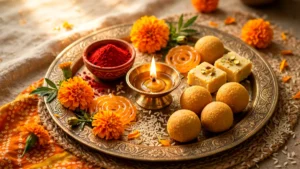
The centre of the day is the prasad. The main dish is Rasiyaav, a rice kheer made with rice, milk and jaggery — gur, in Hindi — instead of refined sugar. Wheat roti goes with it, along with seasonal fruits such as bananas. The food is sattvik — pure and simple, no onion, no garlic. In many homes the kheer is cooked in a new earthen pot over a clay stove.
In the evening, after sunset, the vrati offers the prasad in prayers to the Sun God and to Chhathi Maiya, the mother goddess of the festival. Only after the offering is made does the family eat. The kheer is shared first as prasad, then as the evening meal.
That meal is the last food for a long time. Once it is eaten, the nirjala fast begins — nirjala means without water. For about 36 hours, from Saturday night to Monday morning, the vrati takes no food and no water, until the Usha Arghya on Monday.
What Kharna means
Kharna marks the turn from preparation to the hard part. Day 1 is about cleaning and the first pure meal; Kharna is the last meal before the long fast. The food is simple on purpose — rice, milk, jaggery. The care goes into the cooking: a clean pot, a clean stove, jaggery instead of sugar.
The fast that follows is the heart of Chhath. For about 36 hours the vrati goes without food and water, standing in river water to offer arghya to the setting Sun on Sunday and the rising Sun on Monday. It is kept mostly by women, often for the health and long life of their children and family.
Chhath is the rare Hindu festival that bows to the Sun itself. The setting Sun is thanked on Sunday evening for the strength it has already given; the rising Sun is greeted on Monday morning for the strength it will give.
Some words you will hear today, in plain English. A vrat is a religious fast or vow. A vrati is the person keeping it. Arghya is the offering of water or milk to the Sun. Nirjala means without water. Paran is the breaking of the fast. A soop is the bamboo tray that holds the offerings — thekua, sugarcane, coconut and fruit — at the water’s edge.
Arghya timings: city by city
There is no single national time for either offering. Each ghat follows its own local sunset and sunrise, and the gap between India’s east and west coasts is more than an hour. These are the exact timings from the Times of India.
Sandhya Arghya, Sunday 15 November, at sunset: Kolkata 4:53 PM, Patna 5:01 PM, Delhi 5:28 PM, Mumbai 6:00 PM. Kolkata finishes first, more than an hour before Mumbai. In Patna, families start claiming places along the Ganga ghats by early afternoon.
Usha Arghya, Monday 16 November, at sunrise: Kolkata 5:50 AM, Patna 6:07 AM, Delhi 6:44 AM, Mumbai 6:46 AM. The Delhi and Mumbai figures are worth a second look. Their sunsets on Sunday are 32 minutes apart, but their sunrises on Monday differ by just two minutes.
At the water’s edge, the vrati stands facing the Sun with a soop — the bamboo tray holding thekua, sugarcane, coconut and fruit. Water or milk is poured as the Sun meets the horizon, and the offering should finish while part of the Sun is still visible.
The dawn ritual asks for patience. Devotees enter the water before first light and stand facing east until the Sun appears — only then is the arghya made and the long fast broken, close to 36 hours after it began. Mid-November mornings are often foggy, but fog does not change the time: the arghya is offered at the calculated sunrise time.
For today, Saturday, the Sun sets in Delhi at about 5:28 PM, as per the ABP panchang. The evening Kharna prayers follow sunset, so plan the cooking to be ready before then.
LPG prices: no Kharna-day rise
Some headlines this morning asked how much costlier LPG has become on Kharna. The plain answer for home cylinders is: not at all. Domestic LPG prices have not changed since 7 June 2026 — that is 160 days without a change.
Here are the domestic 14.2 kg cylinder rates today: Delhi Rs 942.00, Mumbai Rs 941.50, Patna Rs 1,031.50, Varanasi Rs 1,005.50, Raipur Rs 1,013.00, Kolkata Rs 968.00, Chennai Rs 957.50. These figures come from Goodreturns’ LPG pages and BankBazaar’s LPG tracker, both checked for today.
Commercial 19 kg cylinders, the kind hotels and sweet shops use, tell a slightly different story. In Delhi a commercial cylinder costs Rs 2,820. In Patna it costs Rs 3,117.50 — the highest of the big cities, and up Rs 17 in November. In Mumbai it costs Rs 2,775. So commercial gas did move a little this month. Home gas did not move at all.
A home cylinder in Patna costs Rs 89.50 more than the same cylinder in Delhi; a commercial one costs Rs 297.50 more. Prices differ by city because of transport cost and local taxes, not because of the festival.
Do not pay extra because of festival headlines. Check the rate before you book a refill. If anyone quotes a “Kharna rate” for a home cylinder, that rate does not exist — the price has been the same since June.
Also read: Delhi AQI 494: hazardous air after Diwali
If you are going to the ghats
Delhi has more than 1,400 ghats ready for Chhath, and 650 special trains are running, as we reported in our 10 November guide.
One thing to plan around is the air. Delhi’s air is very poor today — the Central Pollution Control Board recorded an overall AQI of 348 at 7:05 AM, and North Campus hit 421, in the “severe” band. If you are taking children or older people to the ghats, keep the visit short and carry drinking water.
A word on health: a 36-hour fast with no water is hard on the body. People with medical conditions, or anyone on regular medicine, should talk to a doctor first. No fast is worth a hospital visit.
On Sunday, the ghats will be crowded from the early afternoon, above all in Patna, where families walk to the Ganga in long lines with baskets on their heads. Go early if you want a place at the water, and carry patience as well — the offering takes its own time.
Also read: Bhai Dooj 2026: date, tilak timings and rituals
FAQ
What is Kharna?
Kharna is Day 2 of Chhath Puja, observed today, Saturday 14 November 2026. It is also called Lohanda. Devotees fast all day, then cook jaggery kheer and roti in the evening, offer it in prayers, and eat it. After that meal, the 36-hour nirjala fast begins — no food, no water — until Monday morning.
When does the fast end?
On Monday 16 November, after the Usha Arghya — the offering to the rising Sun. In Delhi that is at 6:44 AM; in Kolkata 5:50 AM, Patna 6:07 AM, Mumbai 6:46 AM. The fast is broken right after, in the ritual called Paran.
Has the LPG price gone up for Chhath?
No. Home cylinder prices have not changed since 7 June 2026. A 14.2 kg cylinder costs Rs 942 in Delhi, Rs 941.50 in Mumbai and Rs 1,031.50 in Patna today. Only commercial 19 kg cylinders moved a little in November — Patna is up Rs 17, to Rs 3,117.50.
Desk-original added context
Our own four-day calendar: 13 November Nahay Khay; 14 November Kharna; 15 November Sandhya Arghya; 16 November Usha Arghya and Paran (Delhi public holiday). Our own timings table, from the Times of India: Sunday sunset offerings run from 4:53 PM in Kolkata to 6:00 PM in Mumbai — a gap of 67 minutes — while Monday sunrise offerings run from 5:50 AM in Kolkata to 6:46 AM in Mumbai. Our own LPG table, from Goodreturns and BankBazaar: seven cities, domestic 14.2 kg from Rs 941.50 in Mumbai to Rs 1,031.50 in Patna. Our own maths: domestic LPG has not changed for 160 days, from 7 June to 14 November. And our own plain reading of the headlines: some reports asked how much costlier LPG had become on Kharna, but the answer for home cylinders is zero — there was no Kharna-day rise.
Sources
- The Times of India — Chhath Puja 2026: Exact Sunrise & Sunset Arghya Timings in Delhi, Patna, Mumbai, and Kolkata (14 Nov 2026, 200 verified; primary source — city-wise arghya timings, soop ritual)
- India TV — Chhath Puja 2026 begins; PM Narendra Modi extends ‘heartfelt wishes to fellow citizens’ (13 Nov 2026, 200 verified; four-day calendar, Kharna kheer and 36-hour fast)
- BankBazaar — LPG Gas Rate Today, 14 Nov 2026 (14 Nov 2026, 200 verified; city-wise domestic LPG rates)
- News18 — Chhath Puja 2026 Kharna: How Is Prasad Prepared? Know Traditional Foods And Puja Vidhi (14 Nov 2026; page loads — verified via search, curl returned 403 bot-block; Rasiyaav kheer, Lohanda, earthen pot)

Sasanka Sekhar Pradhan is the founder of India Presents, an India-focused news site. He covers daily box-office trackers, India news, economy explainers, sports previews and festival guides — in simple English, so readers across India can follow fast-moving stories without jargon. His focus is what a story means for the reader: the number that matters, the source behind it, and what happens next. India Presents publishes daily, with day-trackers updated as new figures come in.