
US President Donald Trump says the war on Iran is “effectively over”. He said it on Monday, 9 November, after meeting Qatar’s prime minister in Washington. Oil prices fell sharply on his words. But Iran pushed back, and the US naval blockade stays in place.
Updated: 10 November 2026, 11:00 IST
Quick Read
- Trump met Qatar PM Sheikh Mohammed bin Abdulrahman Al Thani and Vice President JD Vance in Washington on Monday, 9 November.
- “Iran militarily is effectively over,” Trump told reporters. He added: “We’re just keeping it the status quo.”
- Brent crude fell 5.85% on Monday to $92.57 a barrel, its lowest since late August. It was near $92.33 on Tuesday.
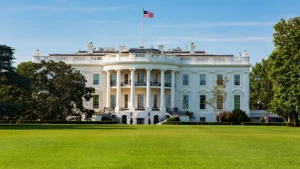
The quote is real, and it is on the record. Trump walked into the White House briefing room on Monday, unannounced, after the closed-door meeting with Qatar’s prime minister. “Iran militarily is effectively over,” he said. “We’re just keeping it the status quo, and we’re doing that really at the behest of countries that are their neighbours.”
He also said talks were going well. “We’re seeing momentum toward the end of this conflict. I think it’s going to be ending fairly soon,” Trump said. He added that a fresh round of strikes now looks “quite unlikely”. The Qatari prime minister called the talks “positive” in a post online.
What “effectively over” does not mean
Read the words with care. Trump did not say the war has a peace deal. He said the fighting is, in military terms, done. The pressure stays. The US naval blockade of Iranian ports goes on. So does Task Force Iron Gate, the new US force set up to hit Iran’s supply routes.
Trump also kept a threat on the table. He said a new US attack, if it came, could be about five times bigger than the first round of strikes. And he said Tehran was “talking very politely” but that US forces stay “locked and loaded”. The message is mixed by design: talks first, force still ready.
The Gulf states back the pause. Trump named them: Qatar, Saudi Arabia, the UAE, Bahrain, and Kuwait. He said they “would prefer the status quo, that we remain as is”. Qatar’s prime minister brought a two-day proposal from Iran to end the war, Al Jazeera reports. That proposal is now part of the talks.
Also read: US task force targets Iran routes: oil at risk
Iran says no
Tehran did not accept Trump’s version. Iranian officials called his remarks “fake news” after he spoke of keeping the status quo. Iran’s security chief, Mohsen Rezaei, told Al Jazeera that Iran has set seven conditions to end the war, and said the US should “surrender” to them. The two sides are not describing the same talks.
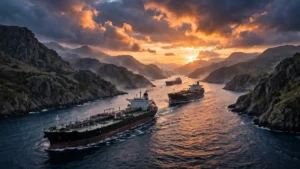
The war began on 28 February 2026, when the US and Israel struck Iran. Since then it has spilled into nearby countries and shaken trade routes. The Strait of Hormuz, the narrow sea lane that carries much of the world’s oil, is still risky. Both the US and Iran have reported attacks on cargo ships in or near the strait. That risk has not gone away, even as oil prices fall.
Oil fell fast — here is the scoreboard
Markets moved the moment Trump spoke. Traders read his words as a sign that new strikes are off the table for now. Brent crude, the world price for oil, fell hard:
| When | Brent crude |
|---|---|
| Last week | Fell about 16% — the steepest weekly drop since Covid began |
| Monday, 9 Nov | Fell 5.85% ($5.75) to $92.57 a barrel — lowest since late August |
| Tuesday, 10 Nov | About $92.33 a barrel in early trade, still sliding |
US crude fell too. WTI dropped 4.4% on Monday to $86.85 a barrel. The fall helps every country that buys oil. It hurts every country that sells it.
Also read: Iran exempts Indian ships from Hormuz curbs
What it means for India
India buys most of the crude oil it uses from abroad. So a lower world oil price is good news. It cuts the import bill, eases pressure on the rupee, and can keep petrol and diesel prices in check. A $5 fall in Brent, like Monday’s, is worth real money across a year of imports.
There is a second India angle: ships. Indian ships pass through or near the Strait of Hormuz. Iran has already exempted Indian ships from its Hormuz curbs, as reported on 8 November. That exemption matters more while attacks on shipping go on. If the talks fail and strikes restart, the strait gets risky again, and the exemption is what keeps Indian cargo moving.
But do not count the savings yet. Three things can still turn the price back up. One, the talks could break down. Two, attacks on tankers near Hormuz could grow. Three, the blockade itself can still snarl supply. Oil at $92 is a relief, not a promise. Watch the talks, and watch the strait.
FAQ
What exactly did Trump say about the Iran war?
“Iran militarily is effectively over,” he told reporters on 9 November after meeting Qatar’s prime minister. He added: “We’re just keeping it the status quo.” He also said the war could end “fairly soon”.
Is the war actually over?
Not by any signed deal. The US naval blockade of Iranian ports continues, and Task Force Iron Gate stays in place. Iran has rejected Trump’s version and set seven conditions of its own.
How far has oil fallen?
Brent crude fell 5.85% on Monday to $92.57 a barrel, its lowest since late August, after falling about 16% last week. On Tuesday it traded near $92.33.
Also read: Trump picks Miller as chief of staff: India link
Sources
- Al Jazeera — After meeting Qatar PM, Trump calls Iran war ‘effectively over’ militarily (9 Nov 2026)
- Economic Times — Iran war is effectively over, Trump says after meeting Qatar PM (10 Nov 2026)
- Vietnam.vn (AFP) — World oil prices plummeted as the likelihood of an attack on Iran decreased (10 Nov 2026)

Sasanka Sekhar Pradhan is the founder of India Presents, an India-focused news site. He covers daily box-office trackers, India news, economy explainers, sports previews and festival guides — in simple English, so readers across India can follow fast-moving stories without jargon. His focus is what a story means for the reader: the number that matters, the source behind it, and what happens next. India Presents publishes daily, with day-trackers updated as new figures come in.

Pingback: US task force targets Iran routes: oil at risk