
Guide: GRAP-3, Delhi’s strictest anti-pollution step so far this winter, is in force across Delhi-NCR since Friday, 6 November. Construction has stopped, some cars are off the roads and primary schools have gone hybrid. Here is what changes for you today, in plain words.
Updated: 8 November 2026, 10:15 AM IST
Quick Read
- The Commission for Air Quality Management (CAQM) invoked Stage III of GRAP on 6 November, two days before Diwali.
- Delhi’s average AQI was 384 at 6 am today — “very poor” — with 11 of 23 stations above 400, in the “severe” band.
- Non-essential construction is halted, BS-III petrol and BS-IV diesel cars are restricted, and primary schools run in hybrid mode.
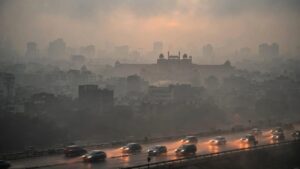
Delhi woke up to thick, grey air on Diwali day. The city’s average Air Quality Index (AQI) was 384 at 6 am and 383 at 8 am, both in the “very poor” band, according to the Central Pollution Control Board (CPCB) as reported by ABP Live, The Indian Express and Business Standard. Eleven of 23 monitoring stations were above 400 at 6 am — that is the “severe” band. Jahangirpuri was the worst at 450. The air is expected to turn “severe” on 8 and 9 November, and stay “very poor” for the six days after that.
That is why GRAP-3 is on. Read on for what it stops, what stays open, and what to do if you must go out today.
What is GRAP?
GRAP stands for Graded Response Action Plan. It is a set of rules for Delhi-NCR — Delhi plus the districts around it in Haryana, Uttar Pradesh and Rajasthan. The rules switch on in steps as the air gets worse. Stage 1 starts when the air turns poor. Stage 2 follows when it turns very poor. Stage 3 is the next step up. Stage 4 is the last and strictest step.
The CAQM, the body that runs GRAP, invoked Stage III on Friday, 6 November — two days ahead of Diwali. It acted early because the forecast was bad: Diwali fireworks, low wind and farm fires in Punjab and Haryana were all set to push the air down together. The early warning system for Delhi had already said the AQI would likely be “severe” on 8 and 9 November.
GRAP-3 at a glance
| Measure | Who it hits | Until when |
|---|---|---|
| Non-essential construction halted | Builders, construction workers, sites across Delhi-NCR | Until CAQM lifts Stage III |
| BS-III petrol cars restricted | Owners of older petrol cars (BS-III or older) | Until Stage III is lifted |
| BS-IV diesel cars restricted | Owners of older diesel cars (BS-IV or older) | Until Stage III is lifted |
| Non-BS-VI vehicles from other states barred | Outstation vehicles not meeting BS-VI norms | Annual ban, 1 Nov to 31 Jan |
| BS-IV-or-lower goods vehicles and buses barred from entering Delhi | Transporters, outstation buses | In force from 1 Nov |
| Hybrid learning for primary schools | Primary-school children and parents | Until Stage III is lifted |
| Stricter checks on polluting vehicles and dust | All vehicle owners, construction sites | Ongoing enforcement |
This table is compiled by this desk from the CAQM order as reported by ABP Live, Business Standard and The Indian Express on 6–8 November. There is no fixed end date: Stage III stays until the air improves and the CAQM says so.
What stops from today
Construction is the biggest change. All non-essential construction and demolition work is halted across Delhi-NCR. That means building sites go quiet. Only work that cannot stop — essential services and emergency repairs — carries on.
Cars are the second change. BS-III petrol cars and BS-IV diesel cars face restrictions on Delhi’s roads. In plain words: BS norms are India’s emission standards, and higher numbers mean cleaner cars. A BS-III petrol car or a BS-IV diesel car is an older, dirtier car, and GRAP-3 keeps it off the road while the air is bad.
Two more vehicle rules started on 1 November and are being enforced hard now. Vehicles registered in other states that do not meet BS-VI norms cannot enter Delhi — this is an annual ban that runs from 1 November to 31 January. And commercial goods vehicles and buses that are BS-IV or older are barred from entering the city.
Also read: Delhi GRAP-3 AQI 365 SC blames vehicles | Delhi AQI Nov 6 Dhanteras 389
What stays open
Daily life does not stop. Shops, offices and markets stay open. The Metro and buses keep running — public transport is part of the answer, not the problem. Hospitals, pharmacies and essential services work as normal.
The Supreme Court is also watching. On 7 November, Chief Justice Surya Kant said old, tried-and-failed steps will not fix Delhi’s air, and pointed at vehicles as the main problem. The next hearing is on 16 November. The court has also ordered daily AQI reports from pollution boards through the Diwali period.
What about schools?
Primary schools have moved to hybrid learning. That means children can attend online or in person, and parents can choose. The idea is simple: small children are hit hardest by bad air, so fewer of them should travel through it. Older classes are not covered by the hybrid order, but schools have been told to cut outdoor activity while the air stays very poor or severe.
How long will GRAP-3 last?
No one has named a date. GRAP stages are lifted when the AQI improves and stays better. The forecast is not kind: the Air Quality Early Warning System says the AQI will likely be “severe” on 8 and 9 November and “very poor” for the six days after that. IITM, the Pune-based weather institute, predicts the AQI could worsen to 406 by Monday morning.
Farm fires add to the problem. ISRO’s INSAT-3DS satellite detected 415 fire pixels in Punjab and Haryana on Saturday. PM2.5 — the tiny dust that harms lungs most — spiked above 600 in some residential areas. That is far above the safe limit.
What are GRAP-1, 2 and 4?
- GRAP-1 (poor air, AQI 201–300): basic controls on dust, open burning and road cleaning. This is the lightest step.
- GRAP-2 (very poor air, AQI 301–400): more curbs — tighter dust control, limits on diesel generators and older vehicles. Delhi was at Stage 2 before 6 November.
- GRAP-3 (severe air, AQI 401–500): construction stops, older cars are restricted, schools go hybrid. This is where Delhi is now.
- GRAP-4 (severe-plus, AQI above 450): the strictest step — trucks stopped from entering Delhi, more vehicles off the roads, and offices and schools shut. Delhi has not reached Stage 4 yet.
Note: the AQI bands above are the CPCB bands (0–50 good, 51–100 satisfactory, 101–200 moderate, 201–300 poor, 301–400 very poor, 401–500 severe). The stage one-liners describe the standard GRAP framework; the Stage III measures in the table above are the ones in force today.
If you must travel today
Today is Diwali, and many people will still go out. A few things help.
Wear a mask. An N95 mask filters the fine dust far better than a cloth mask. Avoid the early morning and late evening, when the smog is thickest and the air is coldest. Take the Metro if you can — it keeps one more car off the road and keeps you out of the smog at traffic signals.
Check the AQI before you leave. If your area’s station reads above 400, keep children and elderly people indoors. People with asthma or heart trouble should stay in and keep medicines close.
Firecrackers have fixed hours today. The Supreme Court has allowed only green crackers — the ones approved by CSIR-NEERI — in Delhi-NCR. The bursting windows today, 8 November, are 6:00–7:00 am and 8:00–10:00 pm. No crackers after 10 pm, and no crackers at all from tomorrow, 9 November. Keep 300 metres away from hospitals, nursing homes, schools and silence zones. Each green-cracker box must carry a QR code and the CSIR-NEERI logo — if it does not, do not buy it.
Delhi AQI today, station by station
| Station | AQI (morning, 8 Nov) | Band |
|---|---|---|
| Jahangirpuri | 450 | Severe |
| Punjabi Bagh | 449–450 | Severe |
| RK Puram | 448 | Severe |
| Bawana | 444–446 | Severe |
| Rohini | 445 | Severe |
| IIT Delhi | 443–446 | Severe |
| NSIT Dwarka | 441 | Severe |
| Chandni Chowk | 420–423 | Severe |
| Patparganj | 421 | Severe |
| India Gate | 398 | Very poor |
| Akshardham | 336 | Very poor |
One warning on the numbers: some outlets reported an overall AQI of 483 at 8:10 am. The CPCB average reported by Business Standard, The Indian Express and ABP Live was 383–384 at 8 am. The 483 figure may come from a different averaging window or a single station. This post uses the CPCB average of 383–384 as the city figure, and the station readings above are the CPCB station figures.
Also read: Delhi Smog 2026: AQI Above 200 — Protect Your Family This Winter
FAQ
Q: What is GRAP-3 and when did it start in Delhi?
A: GRAP-3 is Stage III of the Graded Response Action Plan for Delhi-NCR. The CAQM invoked it on Friday, 6 November 2026, two days before Diwali, because the air was forecast to turn severe.
Q: Which vehicles are banned under GRAP-3?
A: BS-III petrol cars and BS-IV diesel cars are restricted in Delhi. Vehicles from other states that do not meet BS-VI norms are barred until 31 January, and BS-IV-or-lower commercial goods vehicles and buses cannot enter Delhi.
Q: Are schools closed under GRAP-3?
A: No. Primary schools have moved to hybrid learning — parents can choose online or in-person classes. Older classes continue, but schools have been told to cut outdoor activity while the air stays very poor or severe.
Sources
- ABP Live — “Diwali Turns Toxic In Delhi! AQI Nears Severe Mark, 11 Areas Cross 400” (8 Nov 2026): https://news.abplive.com/cities/delhi-aqi-384-diwali-11-monitoring-stations-severe-grap-stage-3-1875155/amp
- Business Standard — “Delhi air remains very poor on Diwali, several stations record severe AQI” (8 Nov 2026): https://www.business-standard.com/india-news/delhi-air-remains-very-poor-on-diwali-several-stations-record-severe-aqi-126110800090_1.html
- The Indian Express — “Delhi AQI Diwali morning: CPCB pollution, Jahangirpuri PM2.5 reading” (8 Nov 2026): https://indianexpress.com/article/cities/delhi/delhi-aqi-diwali-morning-cpcb-pollution-jahangirpuri-pm25-reading-10955239/
- News24 — Delhi air pollution forecast, AQI severe on 8–9 Nov (8 Nov 2026): https://news24online.com/cities/delhi-ncr/delhi-air-pollution-city-chokes-on-toxic-air-on-diwali-as-aqi-crosses-400-in-24-stations-check-imd-weather-forecast-for-next-2-days/951812/

Sasanka Sekhar Pradhan is the founder of India Presents, an India-focused news site. He covers daily box-office trackers, India news, economy explainers, sports previews and festival guides — in simple English, so readers across India can follow fast-moving stories without jargon. His focus is what a story means for the reader: the number that matters, the source behind it, and what happens next. India Presents publishes daily, with day-trackers updated as new figures come in.


Pingback: Delhi green crackers: Nov 7-8 rules, timings